Saturday, 14 July 2012

Hanoverians at the Siege - Gibraltar 1779-83

Extracted from "Geschichte de churhannoverschen Truppen in Gibraltar, Minorca und Ostindien" by Ernst von dem Knesebeck, published in 1845. Available as a google ebook.

To Gibraltar

August de la Motte, the senior Hanoverian commander during the Siege

It soon became clear in 1775 that Britain did not have enough troops to calm the colonial rebellion in America. So the English parliament approached George III, who was also king of Hanover, and they requested the use of Hanoverian troops. He agreed and wrote to Field Marshal von Spoercken to release five battalions. These would be paid by the English, but were only be available for use in Europe, and would be subject to their own rules, justice and religion. The idea was that they could release British garrison troops for the Americas. Two battalions were sent to the island of Minorca, then British, and three to Gibraltar.

das 1. Bataillon von Reden, under Obristlieutenant von Walthausen; replaced by von Dachenhausen when von Walthausen drowned in November 1775

das 1. Bataillon von Hardenberg, later known as von Sydow, under Obristlieutenant von dem Bussche. Von dem Bussche returned to Hannover in 1778 and was replaced by von Hugo.

das 1. Bataillon la Motte, under Obristen la Motte and Major von Schlepegrell.

Each battalion consisted of one grenadier and five musketeer companies, with a total including officers and noncommissioned officers of 473 men, as well as two women. The red and white uniform was remarkably similar to the British troops, though Hanoverian officers wore a characteristic gold sash.

 Gustav Von Dachenhausen

By November 1775 they had been shipped down to Gibraltar, where they were heartily welcomed by the Vice-Governor, Major-General Boyd, and shown to their barracks in the city. The three English regiments that the Hanoverians were replacing were reportedly not best pleased to be leaving for the forests of America, and the Hanoverians soon discovered why. Gibraltar at this time was a very congenial posting, the southern climate was comfortable, the food good, and the Rock interesting. Although most days, after service, the troops were put to work on the fortifications they received a working grant, and most considered themselves well paid.

"Many a trip was undertaken by the Hanoverian officers after the Spanish cities in the area, even to Italy, Africa and the African pirate states. In the fortress were the hospitable rooms of the vice-governor of officers to open once a week, and also to the other days there was no lack of social conversations. The arrival of the first governor (General Elliot) in no way interfered with these pleasant conditions, and soon did this great man's love and respect for the Hanoverian brigade just to win as much as had been both the General Boyd."

Start of the Siege - 1779-1780

Governor Elliot was expecting trouble, but a sudden declaration of war in 1779 took him by surprise. Several officers from the garrison were vacationing in Spain, and one was taken prisoner. The Spanish, based in a camp at San Roque, consisted of 18 battalions of infantry, one battalion of artillery, eight squadrons of cavalry and 4 squadrons of dragoons. At the same time the Bay of Gibraltar was blockaded by a Spanish fleet of three battleships, three frigates and nine smaller vessels. In comparison, the garrison of Gibraltar, had 5 English and 3 Hanoverian battalions, which including the artillery reached a strength of almost 5,400 men. There was also a volunteer corps of Englishmen and Germans, with 2 officers and 80 privates, under Lieutenant Belleville of the La Motte regiment. They had in the harbour one ship of the line, of 60 guns, and three smaller ships.

From July 1779 to mid-January 1780 only 15, mostly in small boats made it past the blockade with food, and lack of meat and fresh food became a  real issue. An armed guard had to be put on the bakers, so great was the demand. The weekly ration of a soldier consisted of 7 pounds of wheat bread or hardtack, 2 pounds of salted beef and 1 pound of salt pork, 4 pints of peas, 3 of oatmeal and 10 ounces of butter. The latter was later withdrawn and replaced by more oatmeal. On 11th January 1780 even this was reduced, with the loss of the pork and one pound of beef. Apart from this though, service in the fortress was not too severe and the health of the soldiers was pretty good. At any one time only 600 out of 6,000 were needed for piquet duty, and time hung heavy for the rest. They were also well protected from enemy fire, only 30 men were lost from the three Hanoverian battalions in 1780.

On the night of 30 September 1st October 1780 the Spanish made a raid on the palisades of the Bay side and caused some damage, but worse was prevented by the "vigilance and intrepidity of two Hanoverian soldiers who were here on duty".

1781 - the counter attack

The relief convoy in April 1781 was a huge relief, with massive celebrations all round, and in fact quite a lot of drunkenness until order was restored. The downside was a huge increase in Spanish bombardment, first against the transports and then against the town. 25 Hanoverians were wounded, and 156 in the garrison as a whole. Monotony was replaced by labour as the bastions were continually repaired, and new ones cut from the rock.

Throughout the autumn work continued on the Spanish side, building more and more batteries, and it was clear that something had to be done. In secret, General Elliot started planning a sortie. He was helped when on 20th November two Spanish deserters arrived, and could give detailed plans of the batteries and their layout. They also described Spanish morale as very low, and the state of things on general to be sloppy. On the night of the 26th November 1781, the British attacked,. It was an incredibly risky operation. They had to cover 500 yards to the Spanish lines, and then another 1,000 to the batteries and there was only one exit, and entry, gate. They were organised into three columns, with Hanoverian troops forming the bulk of the right hand column under von Hugo. This consisted of the von Hardenberg regiment (296 men), together with the grenadier companies of the von Reden and la Motte Regiments (142), the light company of the British 56th Regiment (57) together with 25 artillery men and 50 labourers, 570 in total. The right column was to attack the San Carlos battery on the east of the Spanish lines. The British troops in the centre column were under the Hanoverian Dachenhausen.

 Senior allied officers during the sortie, with Gibraltar behind

At midnight the troops were gathered, and 3 clock in the morning on 27 November, after the moon, which shone very bright, had set, they left Gibralltar. In the darkness they came first across the Spanish Walloon Guard, and upon being challenged Lieutenant Hugo shouted "Krena6iers ällsnovre! " and they rushed the 7ft high barricade with little resistance. A portion of the Hardenberg Regiment had strayed in the darkness and came upon the San Carlos battery unexpectedly, from where they received a volley but they carried on, reinforced by the rest of the Regiment, and this was the only mistake of the night. At a given signal the batteries in Gibraltar opened up and the Spanish, thrown into confusion, retired from the battery line. With incredible speed troops swarmed over the batteries and fascines, attaching wreathes of pitch which they set alight, and spiking the guns. They were covered from counter attack by the combined light and grenadier companies and the Hardenberg Regiment. When trails of powder were lit to the magazines, the order was given to withdraw, again covered by the Hardenberg Regiment, with the magazine exploding like an earthquake before they reached the gate. By 5 o clock they were inside.

The sortie had been incredibly successful, the siege works burned for days and several magazines had been lost, all for remarkably little loss. Of the Hanoverians, the Hardenberg Reigment lost 2 dead and one wounded, von Reden 1 dead, and la Motte escaped casualties.

One consequence of the sallie was increased public perception in England, especially at a time of almost unrelenting bad news. George III, as Hanoverian head of state, promoted La Motte to Lieutenant Genral, and von Hugo and von Dachenhausen to Colonel & Brigadier.

The Spanish now turned their fire again on the city, and much of it was destroyed, though the fortifications were almost untouched. There were again few casualties, though several men from La Motte were lost when one of the magazine at the Willis batteries received a direct hit and exploded. But conditions on the Rock were now worse than ever, the troops sleeping in tents, many of the non-combatants in whatever ruins or huts they could find. There was plenty of salt beef, but no fresh food, and scurvy broke out again.

1782-4 - the Grand Bombardment and home.
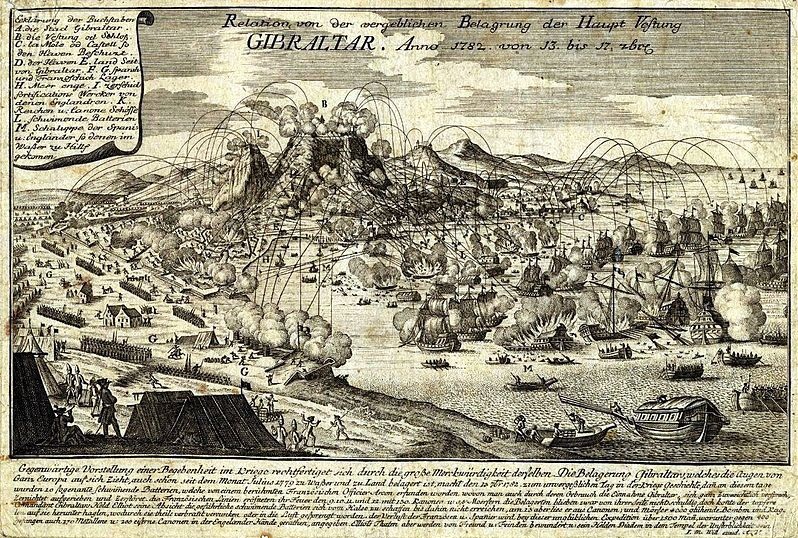
A German (Hanoverian?) portrayal of the bombardment

During the early months of 1782 the Spanish reconstructed their earthworks, with no expense being spared, and of course, defences much improved. They also considered what new methods they could use, even poison gas, but they decided to build floating batteries, and this went ahead in great secrecy. Meanwhile, the British and Hanoverians had been strenghtened to 7,500 men, and were making innovations of their own, including a cannon which could be depressed 20 degrees, for firing from the great height of the Rock. They also developed "heated shot". Actually, this wasn't new, but was hardly ever used as it was technically very difficult, the heat tending to ignite the powder of the cannon prematurely. But they had lots of cannons, and time, to play with and eventually got it right. A sergeant in the La Motte Regiment, Schwependik, a blacksmith by trade, invented an oven that could produce several glowing shot at once. He received a life long pension from the English government.

The Spanish also built up their assault forces, under the command of the Duke of Crillon, who had just captured the island of Minorca, and the Hannoverian garrison there. There was also a French corps under Falkenhayn of 4,000 men, which although small in comparison to the Spanish forces, almost matched the garrison by itself. There were many more cannon, more ships, and the floating batteries. There were also landing craft, flat bottomed to convey troops across the bay after the defences had been pounded to rubble. It looked like this time the Spanish could not possibly fail.

On 9th September 1782 all the land batteries and gun boats started firing, joined on the 12th by a Franco Spanish fleet, and on the 13th by the floating batteries, which were meant to bear the brunt of the attack. The British responded by the heaviest fire they could manage, concentrated initially on the boats towing the floating batteries, which were crewed by criminals as the work was so obviously dangerous. To their dismay the British found that the floating batteries themselves were more or less immune to cannon fire. Only the heated shot seemed to make any impression, and even then the artillery battle went on for hours. By 3pm smoke was blowing around the bay, but it was not until 8pm that the garrison could see boats evacuating crews from the floating batteries. By 11pm a shipwrecked Spanish ship bought news that the Spanish were starting to retire, but still the battle kept on, artillery crews replaced with sailors who knew how to work the guns. By 3am several floating batteries could be seen in flames, which only served to illuminate the others to make better targets. Before daybreak a counterattack with gunboats drove off the boats protecting the batteries and the danger was over. Overall, Spanish losses were estimated at about 2,000, losses in the garrison were just 16 killed and 69 wounded.

Although moral in the siege lines was now low, the Spanish court did not give up, and the blockade continued. Fresh food was still low. The arrival of Howe's convoy in October relieved matters though, and brought the garrison up to 8,000 men. Spanish preparations for another attack continues, but halfheartedly, and in February 1783 news came of the Treaty of Versailles. On March 12th Governor Elloit met the Duke of Crillon outside the walls, they shook hands and peace was declared.

It was over a year before the Hanoverian brigade could return home, but in August 1784 they embarked and in September they were back in the river Weser at Geestendorf (Bremerhaven). They were met by Major Genreral von Busse and one by one discharged from English service. They marched to their respective garrisons at Nienburg, Verden and Hameln, where they were received as heroes.

As an aside, the three Hanoverian Regiments were granted the battle honour "Gibraltar". Their successors in the German Army still carried this into World War 1.

Wednesday, 11 July 2012

The Largest Battle of the American Revolution

Was this Saratoga? Yorktown? No, it was the siege of Gibraltar, empathising how world wide this conflict really was.

The Siege

Gibraltar ("The Rock") had been ceded to Britain in the Treaty of Utrecht in 1713, ""for ever, without any exception or impediment whatsoever", but Spain had been trying to renege on the treaty ever since. In 1779, with Britain alone against Spain, France, Holland and revolting American colonists, the opportunity seemed to there for the taking.

Spain laid siege with 13,000 men under Martín Álvarez de Sotomayor, including two battalions each of Royal Guards and Walloon Guards of the Spanish army, whilst the cavalry included French Dragoons. There was also a blockade on the seaward side, based at Algiciras, and another Spanish squadron at Cadiz to block reinforcements.

The British, under Governor General Elliot, had 5,382 troops including a Corsican contingent and a Hanoverian Brigade of three battalions. Fortunately, Elliot turned out to be an inspiring and determined leader. And a conscientious one, he had been laying in stores and preparing defences for some time.


The Defences

The only landward route to Gibraltar was, and is, across a narrow isthmus. Every effort had been made to cover this with as many cannon as possible. Directly across the causeway was a wall and dry ditch with two bastions, mounting 26 guns. Flanking this, and the causeway itself were the King's, Queen's, and Prince's lines cut out of the rock itself. Above were the Willis batteries, and then further batteries up the Rock until the summit, which was crowned with cannon and mortars. The Mole, projecting out past the harbour, was itself fortified and gave a crossfire onto the causeway. There was so much artillery that 100 British infantry were detailed to help man the cannons. The whole was so formidable that it was called the Mouth of Fire by the Spanish. The seaward side was equally covered with bastions and cannon from sea level to the summit, with barriers of old masts and chains blocking the old and new landing stages. Only the Eastern flank, which is a sheer drop into the sea, was unfortified and left to the famous Gibraltar apes. Last, but not least, a huge cistern had been made to collect rain water, so that at no point in the siege was there a shortage of water.

The Spanish troops constructed huge siege works around Gibraltar, and the blockade started to bite. By the winter Gibraltar, with virtually no room to grow food, was starting to suffer. Scurvy, caused by a shortage of fresh vegetables, was common and ships had to be broken up to get firewood. What saved Gibraltar was the Battle of Cape Vincent in January 1780, A massive British convoy under Admiral Rodney not only smashed through the Spanish blocking force at Cadiz, but captured or destroyed 4 ships of the line, including the Spanish flagship. This, the supplies landed, and reinforcement with the 73rd Highlanders gave a huge boost to the garrison morale. The presence of Prince William, son of the King, in the fleet also showed commitment from Britain, and that the garrison was not forgotten.

 The Battle of Cape St. Vincent

Running the Blockade

By the summer of 1780 food was running low again, but blockade runners kept them going. Every effort was made to bring in fresh fruit from Africa to hold off scurvy.

Admiralty-Office, September. 18, 1781.
Extract of a Letter from Captain Curtis dated Brilliant, Gibraltar, August 7.
I beg Leave to acquaint My Lords Commissioners that His Majesty's Sloop Helena arrived here this Morning. Her Approach was discovered by the Enemy and us at the same Time, about Five o'Clock. She was in the Gut to the Southward of Cabarita Point, and nearly a Third of the Way over from it towards Europa. It was perfectly calm, and the Helena was rowing for the Rock.

I immediately took the Repulse and Vanguard Gun-Boats, with all the Boats of the Ships; and went for her, as expeditiously as possible. Fourteen Gun-Boats of the Enemy, carrying each One Twenty-six Pounder in the Bow,, moved also from Algaziras, accompanied by several Launcbes. These Boats got on faster than I could proceed with the Repulse and Vanguard, and before Eight o'Clock those of them the most advanced commenced their Fire upon the Helena, being then within Half Gun-shot. She returned it with great Deliberation and Effect, but still continuing to use her Oars. The greater Part of the Gun-Boats were soon close to her, and the Clouds of Grape and other Shot, that seemed almost to bury her were really astonishing. However she could not, without our Aid, bear long this very unequal Combat. The Repulse and Vanguard began a well-directed Fire upon the Enemy, being so placed as was deemed the most efficacious to cover the Helena, and annoy them. 

The commencement of the Sea Breeze having got to the Helena she soon reached us, the Enemy still persevering on their attempt upon her, firing at her broadside and others keeping astern, raking her. However the Steadiness and Bravery exhibited onboad the Helena, and the well appointed Grape from the Repluse and Vanguard, very soon made some of them retire, and they had all fled by ten o Clock, allowing us to tow the Helena into the Mole without further molestation. A Xebec, mounting between twenty and thirty guns, which was lying near to Cabarita Point, got under way when the Breeze came and advanced to join the Gun Boats, but upon seeing them retire she retired also.

The Masts, Sails, Rigging and Furniture of the Helena are cut all to Pieces, and the Hull a good deal damaged, but it is as wonderful as it is fortunate that the Boatswain was the only man who was killed on board her.  The Bravery, the Coolness, and the Judicious Conduct of Captain Roberts do him infinite Honour and His Officers and Men deserve the highest Commendation.
London Gazette

On 7th June the Spanish sent a fire ship into the harbour. This nearly worked, but the garrison was alerted and at 1am woke to see Gibraltar blood red against the dark night. Cannonades drove off the Spanish boats, and English boats rowed out, hooked the burning vessel, and towed it away. Even then the danger was not over, two more fireships were approaching and almost reaching the pier, but they were fended off just in time. The hulks were later salvaged by the British and used, ironically, as firewood

Yet again food started to run out, especially as supplies from North Africa had been cut, but another convoy arrived in April 1781, and this convoy evacuated all civilians from the Rock.

The Sortie and the Grand Bombardment

It was now clear to the Spanish and French that the British could not be starved out. So in November they assembled ready to storm the defences. the British response took them entirely by surprise. The night before the assault was due fully half the garrison silently left Gibraltar and then flung themselves on the siege lines. It was a dramatic success, batteries were set on fire, cannon spiked and troops routed. Over two million pounds worth of Spanish stores and equipment, an immense sum for the time, was destroyed. the assault had to be cancelled.

 Watching the destruction of the Spanish floating batteries from The Rock

But still the Spanish and French persisted. Eventually, on 13 September 1782, nearly three years after the siege started, they started their assault. The plan was to smash Gibraltar´s defences "into powder" and then storm it with 35,000 Spanish and French troops. A fleet of 18 ships of the line, 40 gunboats and 20 bomb vessels surrounded the Rock, as well ten "floating batteries" with 138 heavy guns. These were immense, with guns only on one side, counterbalanced with lead. The cannon side had extra protection, and a roof was made of planks and iron sheets. They were, in a way, the first Ironclads. On the landward side there were 86 more guns. Over 80,000 spectators gathered to watch the show - they were disappointed. The British batteries, with higher elevation, and therefore range, fired red hot shot at the wooden floating batteries, exploding three and damaging the rest. They also damaged the ships so much that they caused 719 casualties. Demoralised, the allies withdrew.

This was the last major assault. In October another large British convoy appeared, 31 transports with supplies and the 25th, 59th and 79th regiments. The siege continued but in February 1783 a peace treaty was signed. Although the British bargaining position was weak the Spanish didn´t press for Gibraltar, gaining instead Minorca and territory in the Americas. Presumably they assumed Gibraltar could be picked off at a later date. It wasn´t.

Saturday, 7 July 2012

The mid Victorian Swiss Army

For Switzerland, the Europe of the mid 19th century was a dangerous place. France under the glory seeking Napoleon III to the west, a Prussia bent on becoming a superpower to the north, the traditional enemy Austria to the east and a fiercely ambitious Italy to the south. Switzerland was very much a federation of cantons, each mostly self governing, though since 1848 the Federal Assembly had responsibility for defence. The problem with this was that they were especially vulnerable to salami tactics, cantons picked off one by one. With French, German and Italian speaking cantons, and Prussia and Italy determined to unite the German and Italian speaking peoples, Switzerland was especially vulnerable. This is their response.

 Swiss uniforms 1857

1855 - The Swiss Army (Putnam's Magazine)

In Switzerland no national standing army exists. Every Swiss is compelled to serve in the militia, if able-bodied; and this mass is divided into three levies according to age. The young men, during the first years of service, are called out separately for drill, and collected from time to time in camps; but whoever has seen the awkward gait and uncomfortable appearance of a Swiss squad, or heard the jokes they crack with the drill-sergeant while under drill, must at once see that the military qualities of the men are but very poorly developed. The organization of the militia is almost entirely in the hands of the various cantonal governments; and, though its general form is fixed by federal laws, and a federal staff is at the head of the whole, this system cannot fail to create confusion and want of uniformity, while it must almost necessarily prevent a proper accumulation of stores, the introduction of improvements, and the permanent fortification of important points, especially on the side where Switzerland is weak, toward Germany.

The Swiss, like all mountaineers, make capital soldiers when drilled; and, wherever they have served as regular troops under foreign banners, they have fought exceedingly well. But being rather slow-headed, they need drilling much more, indeed, than either French or North Germans, to give them confidence in themselves, and cohesion. It is possible that national feeling might possibly replace this in the case of a foreign attack upon Switzerland, but even this is very doubtful. An army of 80,000 regular troops, and less, would certainly bo a match for all the 160,000 and more men which the Swiss say they can congregate. In 1799, the French finished the business with a few regiments.

 A Swiss sharpshooter 1852 (New York Digital Library)

The Swiss boast a great deal of the rifles of their sharp-shooters. There are, certainly, in Switzerland, comparatively more good shots than in any other European country, the Austrian Alpine possessions excepted. But when one sees how these dead shots, when called in, are almost all armed with clumsy common percussion muskets, the respect for the Swiss sharp-shooters is considerably lessened. The few battalions of rifles may be good shots, but their short, heavy pieces (stutzen) are antiquated and worthless, and their awkward, slow method of loading, with loose powder from a horn, would give them but a poor chance when opposed to troops armed with less superannuated weapons.


Altogether, arms, accoutrements, organization, drill, everything is old-fashioned with the Swiss, and very likely will remain so as long as the cantonal governments have anything to say on the subject.

The Neuchatel Crisis of 1856


Swiss troops at Mamertshofen castle in the winter of 1856/7

There were very few states that faced down Prussia in the 19th century, but Switzerland was one of them.
To understand the Neuchatel crisis you have to remember that Switzerland was not a unitary state, but a loose federation of semi-independent cantons. One of these, Neuchatel, was ruled by the King of Prussia, but as head of state, not as part of Prussia, Neuchatel was still part of Switzerland. In 1848 Neuchatel had rebelled and kicked out the Prussians, but in 1856 Royalists attempted a coup, to bring back the Prussian king, William. It failed, and the plotters were captured, but Prussia made its move. William demanded the release of the rebels and backed that up with a threat of military intervention. Thirty thousand Federation troops were mobilised and stationed along the Rhine, the border, against 110,000 Prussians.
Faced with opposition from Britain, France and Russia, Prussia backed down. In 1862 Count Otto von Bismarck took over, and from then on Prussian conquests were much more sure footed.

 Swiss troops during the crisis

1861 (The New American Cyclopedia)

The Swiss army consists entirely of militia, and is divided into 3 classes: 1, the regular army, composed of men between 20 and 33 years of age, to the number of 3 per cent, of the population; 2, the reserve, consisting of men between 33 and 40 who have served their time in the regular corps; 3, the landwehr, comprising all men under 44 years of age who are fit to bear arms and are not serving in either of the other divisions. The strength of the army in March, 1860, was as follows: regular force, about 90,000; reserve, 51,000; landwehr, 43,000; total, 184,000. Probably over 100,000 could be brought into the field at a few days' notice. The organization is very complete, and for celerity of movement and concentration the Swiss army will compare favorably with any in the world.

1862 (From the Stateman's Yearbook of 1865)

The army numbers 80,000 men, and 120 companies of "sharpshooters," comprising 8,712 picked riflemen. The cavalry comprises 2,911 men, divided into 35 companies, and the artillery, 12,400 men, with four "mountain batteries," of 10 guns each, and eight "rocket batteries", besides twelve companies of sappers and miners.

1864 (The Eclectic Magazine: foreign literature, Volume 63)


It would not be fair to omit Switzerland from this comparative list, especially as the organization of her army, like that of Great Britain, possesses special and peculiar features of its own. Switzerland, in fact, disclaims the idea of having a standing army; her constitution prohibiting the existence of one within the limits of the Confederation. However, not to leave the commonwealth without a system of defense, every one is expected to be trained to arms, and nearly every one is so trained. Children from the age of eight are regularly instructed at the upper and middle schools in military exercises, undergo special examinations, and are frequently paraded and reviewed with all the pomp and eclat of veteran troops. When they have gone through their infantry exercises, and have become expert in the use of the rifle—Wimbledon has witnessed some of the excellent shooting of these gallant and keen-eyed sons of the Oberland—the young Tells practice gunnery, two and four pounders being supplied by the government for that purpose.  The total amount of this patriotic force—like the Spartans of old, every Swiss feels he fights, when he does fight, for his institutions, and therefore fights with the purest feelings of patriotism—is 339,926 men; a large number for so small a commonwealth. Only the Bundesausug, however, is on active duty, and the service of these is light and easy.  The policy of the government has invariably been unaggressive, and rarely has the army of Switzerland been called into the field. The arrogant claims of the late King of Prussia on Neuchatel was the last occasion on which the Swiss spirit was roused; but a show of popular indignation sufficed to puff out the ambition of a Pourtales and the pretensions of the crowned Hohenzollern.

 Carabiniers 1860 (New York Digital Library)

1869 - The Vetterli Rifle

Military technology made huge strides during this period, and so did infantry fire power. Rather than buy from outside the Swiss designed their own, the Vetterli rifle. Johann-Friedrich Vetterli (1822–1882) had worked in both England and Frenace before becoming director of the Schweizerische Industrie Gesellschaft's armament factory.
The 1869 Repetiergewehr (repeating rifle) Vetterli came on stream in 1869 It combined the magazine of the American M1866 Winchester rifle, the bolt system of the Prussian Dreyse needle gun and a novel self cocking action and at the time it was the most advanced in Europe. It was soon followed by the 1871 version, and continued in use until 1890.

1869 (Reflections on the Formation of Armies, With a View to the Re-organization by Walter James Wyatt)

The Swiss Army.
The thirteenth Article of the Constitution of September 13th, 1848, forbids the maintenance of a standing army within the limits of the Confederation. To provide for the defence of the country, every citizen has to bear arms, in the management of which the children are instructed at school, from the age of eight, and they pass through regular exercises and public reviews. Such military instruction is voluntary on the part of the children, but is participated by the greater number of pupils at the upper and middle-class schools. They not only go through the infantry exercises, but practice gunnery, the necessary rifles and cannon—-the latter 2 and 4 pounders— being furnished by the Federal Government.


The troops of the republic are divided into four classes, namely:—


1. The " Bundesauszug," or Federal army, consisting of all men able to bear arms from the age of 20 to 34. All cantons are obliged, by the terms of the Constitution, to furnish at least 3 per cent, of their population to the "Bundesauszug."
2. The army of reserve, consisting of all men who have served in the first-class, from the age of 35 to 40. The numbers are calculated to amount to 1J per cent, of the population.
3. The "Landwehr," or militia, comprising all men from the 41st to the 45th year.
4. The "Landsturm," or army of defence, including all men above 45, till the term when they are disabled by age from military service.

Swiss Federal Infantry (New York Digital Libray)

1871 (The Franco-Prussian War)

The first ever complete mobilisation of the Canton forces came in 1871, a defensive measure during the Franco Prussian war, to make sure neither side strayed across the border. Apart from anything else, they had responsibility for disarming 87,000 French soldiers of the French Armee d'Est, who asked for asylum and were interned for 6 weeks. It didn't help that the internees were arriving through Neuchatel, and the pursuing Prussian army might well seize the chance to take it back. But they didn't, and the enormous military and humanitarian operation did a lot for Switzerland's reputation in Europe.

 Swiss troops recieving French zouaves 1871

1871 (The American Annual Cyclopedia and Register of Important Events)

SWITZERLAND, a federal republic in Europe. Area, 15,722 square miles; population, in 1860, 2,510,494; of which 1,476,982 aro Protestants, and 1,023,430 Roman Catholics.
The staff of the army, on April 15, 1870, was composed of 76 colonels, 93 lieutenantcolonels, 130 majors, 226 captains, and 292 lieutenants.


Immediately upon the outbreak of the war between France and Germany, and notwithstanding the friendly assurances of France and Prussia that the neutrality of Switzerland was to be strictly respected, the Federal Government determined to place such a force on its frontiers as would render a violation of Helvetic territory a more difficult undertaking than if it were only defended by a respect for existing treaties. In little more than a week's time, through the military organization of the republic, in which every man is a soldier, either in the active contingent, or in the reserve, or the landwehr, five divisions were called to arms, and marched to the most threatened part of the frontier, the line separating Switzerland from Baden. These corps formed an effective force of 50,000 men. The Government issued treasury bills to the amount of 5,000,000 francs, bearing interest at the rate of four and a half per cent, per annum, and the money was immediately furnished by Swiss bankers and capitalists. During the latter part of August, the Government consulted with General Herzog, commander-in-chief of the Swiss Army, and, upon his advice, recalled the entire military force on the frontier, leaving only two battalions of sharp-shooters as a corps of observation.

Tuesday, 3 July 2012

Gibraltar of the West - Bermuda in the 1860s

After losing the southern American colonies in the American Revolution, Britain started developing Bermuda as a naval base.The other alternative was Halifax in Nova Scotia, which had an excellent harbour. - but one significant disadvantage, it could be reached overland from the United States. Nonetheless, until 1868 Bermuda was part of the Nova Scotia command, for much of that time more or less an outpost of Halifax. For the Navy this had the advantage that ships could be rotated between the two, Halifax being regarded as much healthier. In the same way, ships were often sent north to Bermuda from the Caribbean when there was sickness in the crew. Even then, disease was often a problem. In 1868 an outbreak of fever and diarrhoea struck the Bermuda garrison - out of 3,519 men 1,665 were admitted to hospital. The official report at the time stated...
"This outbreak of fever was attributed by the Principal Medical Officer "to the "effects of a sudden change from the cold bracing climate of New Brunswick "to the hot relaxing climate of Bermuda." The exemption of the Royal Artillery from fever is attributed to their having previously served at Gibraltar, and thus being more inured to the heat, and to their duties being lighter than those of the other troops."

The population of Bermuda was also unaffected. At least the scale of the outbreak led to many improvements in conditions at the barracks, as well as recommendations that troops arrive during the autumn so that they can acclimatise slowly.

Bermuda and the American Civil War

    Bermuda´s military value had been amply demonstrated during the war of 1812, when privateers from Bermuda captured 298 American ships, and Bermuda was a staging post for amphibious operations such as the capture of Washington. Very much the same considerations were voiced by Sir Alexander Milne, the commander of the North American and West Indian Squadron during the American Civil War,

 "If Bermuda were in the hands of any other nation,the base of our operations would be removed to the two extremes, Halifax and Jamaica, and the loss of this island as a Naval Establishment would be a National misfortune."


HMS Challenger in Bermuda 1865. Like many of the Victorian steam corvettes she had a story to tell. In 1862 she had been part of the force that occupied Vera Cruz in Mexico, whilst in 66 and 68 she was in action in Fiji. But her contribution to history is as the worlds first oceanographic ship on the Challenger Expedition. The Space Shuttle Challenger was named after her.

Thus Bermuda was essential during the War between the States as a projection of the British navy, but it was also greatly valued by the Confederates as a "neutral" port, where they could trade war supplies, or even just stock up on coal. The Globe Hotel was so established as a centre for Confederate agents there is a museum commemorating this there today. For example, in March 1862 the SS Bermuda passed through with a cargo of guns and ammunition, whilst on 3 April 1863 the steamer General Beauregard with a cargo of "Enfield rifles, 1 field battery of guns complete, 500 bags saltpetre, blankets etc was in the harbour. The prosperity generated made the Confederacy very popular amongst Bermudan traders, and there was a large community from the Southern States.

 The USS Sonoma & Tioga off Bermuda

Conversely, the United States were far from popular. Not least after the actions of Commander Charles Wilkes, who seems to have been almost determined to cause a war. In command of a small squadron, the Wachusett, Sonoma and Tioga , he sailed into St Georges harbour, and not only refused to leave for a week but ordrered the two gun boats in his squadron to blockade the harbour, even firing on a Royal Mail cutter, the Merlin. It was Wilkes who later cuased the "Trent Affair" by stopping and boarding the British mail packet Trent and seizing two Confederate commissioners aboard.

The Dockyard

 
 HMS Vixen, an armoured gunboat, in Bermuda dockyard.

    Bermudas´s location was militarily perfect, but there were  disadvantages. For a start, there were not many deep water channels suitable, although eventually a suitable site was found on Ireland Island, on the extreme western tip of Bermuda. Unfortunately, the main settlement was St. Georges, at the eastern end of the island, whilst the official capital, government buildings and garrison headquarters were at Hamilton, in the centre. Nonetheless by 1864 the Duke of Somerset could report that.....

    "During the last twenty years much has been done to render Bermuda an important naval Station, more especially while Rear-Admiral Hutton was Superintendent. The old floating depots for provisions, naval stores, &c. have been abandoned, and a fine dock and victualling yard have been built with a basin of more than sixteen acres, and a jetty for coaling ships, at a cost of about £112,000: the construction of a first-class dock would complete the establishment. Bermuda lies in a central position, which is the key to the North American United States in case of war: it is a convenient distance from Halifax to vessels which might be injured in the Gulf Stream, and it is convenient also with regard to the West India Islands. Engineers have, however, contended that there are natural difficulties which are insurmountable, "owing," as one of them says, "to the ground being so porous and uncertain. You may go through a solid piece of rock, five, six, or ten feet, and you may come into a cavern connected with the ocean sixty or seventy feet deep: the openings in the rock are something very extraordinary. In Bermuda there are caves which will astonish you: the connexion between the rock and the sea is surprising : you cannot go fifty feet without getting to something which would upset your arrangements."
    United Service magazine 1864

    This porous rock was a problem. Maintenance of a fleet "on station" required a dry dock, but the nature of the rock made this impossible. The ingenious, but hugely expensive, alternative, was to make a floating dock, in England, and float it down to Bermuda.

    By 1869 though it could be reported that
    "The floating dock at Bermuda which was launched last year, and is so far successful, is paid for, having cost altogether about .£300,000. It is a most ingenious construction, and 18 well worth the money spent upon it It will be most useful, as it is much better to repair ships at Bermuda, if possible, instead of sending them home."
    Colburns United Services Magazine 1869

 The floating dock arriving at Bermuda

    The dock was towed to Madeira, where HMS Warrior and HMS Black Prince took over and continued the voyage to Bermuda, with the paddle frigate HMS Terrible lashed astern to act as a rudder, the voyage lasting 39 days. This was partly because of the sheer power needed to tow the dock, but it also sent a message that Britain had bigger and better ironclands than the United Staes, and was committed to defending her American and Atlantic territories.

Defences

    All of this made Bermuda an obvious target for attack, and from the 1850s to 1860s fortifications were substantially upgraded, and the garrison increased. Given that since the 1840s a string of American government spies had been making reports on the islands defences, and how they might be overcome, the concern was probably warrented. The main centres were;

a) St Georges garrison
The original, on the Eastern side of the island.

b) The dockyard garrison
Protecting the Naval dockyard, with ranges for training of marines.

 The barracks on Ireland Island, 1848

c) Prospect camp
By 1860 this was the site of the main garrison on the island, with barracks, training areas and a fort, Fort Prospect, manned by the Royal Garrison Artillery. As well as Fort Prospect there were two other forts, Fort Hamilton and Fort Langton, sited to give overlapping fire. Fort Hamilton, completed in the 1870s, was on a site of 10 acres and carried 18 guns and was surrounded by a moat.

In fact Bermuda was dotted with fortifications.

 In the East, at St Georges, there was Fort St Catherine, the largest on the island. like much of the defences, expanded and upgraded during the 1860s. Designed to cooperate with St Catherine were Fort Victoria, whose 18x 32 pound cannon commanded the approaches to the dockyard, and Fort Albert, built in 1840, a moated pentagon redoubt with 4 heavy guns, two eight inch howitzers and two ten inch mortars. In 1865 the heavy guns of Fort Albert were replaced with modern ten inch rifled muzzle loaders.

At the dockyard end of the island  there was Fort Scaur, sited to prevent attack on the docks from the landward side, with a dry moat and "disappearing carriages". These were pulled back out of sight of the enemy for reloading, and the whole fort was designed to present a miminal target to the enemy.

    There was a martello tower at Ferry Reach, with a garrison of 24 men and one officer and two ammunition stores, one on Ordinance Island (!), connected by a causeway to the main island, and one at East Broadway, near Hamilton.

During this period the number of troops had also been increased substantially, and by 1865 there were over 6,000 troops on the island. Regiments included, at various times,  the 2nd battalion of the 2nd Queens Regiment, and the 15th, 30th and 61st Regiments.

Bermuda continues to be a British Overseas Territory today, although, ironically, it was an important base for American units during WW2.

Sunday, 24 June 2012

Interdiction off the Brazilian coast in the 1840s

If active service for the Army of the 1840s meant India, for the Navy it meant the Slave Trade, patroling West Africa, the Caribbean and the Brazilian coast and attempting to apprehend slave traders. This was a job for fast small ships, not the battle fleet.

Of course, cruising the open ocean looking for slavers was a waste of time, the patrols were off the African and Brazilian coasts. Technically Brazil had banned the trade in slaves, but as this article by Commader Foote R.N. in the United Services Journal of 1845 shows, that wasn't quite the case.

 A slave market in Rio

A FEW REMARKS ON THE SLAVE-TRADE IN THE BRAZILS.

When we see slave-vessels fitting out in every port of the empire of Brazils, from Para to St. Catherine's, openly protected by the authorities; when we see slaves landed and sold within a few miles of the Emperor's palace at Rio de Janeiro, and the vessel, after discharging her cargo, fearlessly enters the harbour, triumphing in her success; whilst the authorities refuse, and British cruisers are unable to interfere, being once within three miles of their coast, it will be perceived how utterly useless it is to trust to the good faith or co-operation of the Brazilians in such a matter.


Not more than two or three years ago, a boat belonging to H.M.S. Clio ( a brig sloop carrying 71 men and 18 guns).was attacked on the coast of the province of Esperito Santo, when in possession of a slave-vessel, having more than three hundred Africans on board, by a great number of large boats and canoes full of men, who re-captured and burnt the vessel, having landed all the Negroes.

This attack was made in the presence, if not by the direction, of the Juiz de Paz of the district. The boat, obliged to retreat, in want of water, and unable to reach the Clio, put into the port of Campos (about forty miles distant); she went in with her ensign and pendant flying, and the officer (a Lieutenant) proceeded on shore, with his side arms, to purchase refreshments, when, to his surprise, he and the whole of his crew, consisting of a Midshipman and thirteen men, were seized, and thrust into one common prison, where they could with great difficulty procure the common necessaries of life. The authorities then caused the English colours to be hauled down on board the boat, and took possession of her. The officers and crew remained several days in prison, until the Clio arrived off the port, where, being unable to enter, from the shallowness of the water, she threatened a blockade; and they were released.


A boat, belonging to H.M.S. Rose (18-gun sloop), having captured a vessel with 280 Africans on board, and sent her to Rio Janeiro, again resumed her cruising ground. The officer and crew landed one morning to cook their breakfast on the rocks, when they found themselves suddenly surrounded by a great number of men on horseback, all armed, who made them prisoners (the boat's crew having, by order, left their arms in their boat), and conducted them on foot to the town of Campos, a distance of about fifteen miles, where they were, in a similar manner to the Clio's boat's crew, lodged in prison. The cause for this sudden and unwarrantable behaviour was the appearance of a slaver in the offing, and the Rose's boat was actually employed by the slave-dealers in embarking the Negroes from this newly-arrived vessel, which being accomplished, she ran into Campos, whither also the boat was conducted. The Commander of the Rose having become acquainted with the fate of his boat and crew, detained several coasting vessels at the mouth of the Campos river, and sent an officer to demand the immediate restoration of his men; they were in consequence given up. No satisfaction whatever has been offered for this outrage. The Juiz de Paz still retains his office, still continues to receive the usual bribes for the disembarkation of Negroes, and still continues to animate the ignorant country people by whom he is surrounded against the English pirates!


The slave-dealers, secretly applauded by the Government, and encouraged by these successful attempts to insult the British flag, now armed themselves at the different slave stations, and came to the determination of firing into any boat which took refuge in their ports or creeks, or even approached the coast within musket-shot. An opportunity soon presented itself. A boat, belonging to H.M.'s sloop Fantome (16-gun Acorn-class brig-sloop) anchored one evening in a little creek at the Ilha Grande, for protection from the wind and sea; a few men came down to the rocks, and asked if they were English. The officer in charge of the boat answered in the affirmative, and pointed to the colours which were flying. At peep of day on the following morning they were awakened by a volley of small arms, and several balls passed through the hull of the boat; but as the men were fortunately lying down at the time, two only were wounded, one receiving a shot through his hand, and the side of another being grazed. One of the same men who came down to the rocks on the previous evening was distinctly recognised, with about twenty or thirty others (mulattoes and blacks), all armed with muskets. The officer s first impulse was to slip the cable and dash at them, and the men in the boat were most eager to do so, as the people on shore were concealed behind the rocks, and were firing whenever they could get their old broken-down muskets to go off; but he (the officer) had received positive orders not to land on any account whatever; and he consequently retired, trusting that a proper representation of the case would be sufficient to procure instant redress; but the only satisfaction the British Minister ever received was the empty assurance of the Brazilian Government that they had caused an inquiry to be instituted, and that the man who had authorised and headed the attack had fled from the island, and could not be found, although he was seen and recognised by the same officer not six weeks after the occurrence.


At Santos, a seaport in the province of St. Paul's, the slave-trade is carried on with greater vigour and less secrecy than in any other part of the Brazils. It was in this port that Captain Willis, of the Frolic, and his officers, were waylaid, and nearly murdered, and slave-vessels are here fitted out with every necessary equipment, which is taken on board in the open day; they sail with no cargo, with the exception of slave-provisions and water, and it is so arranged that they shall not wait more than six hours on the coast of Africa, the slaves having been previously collected and prepared for instant embarkation.


One of the most notorious and iniquitous traffickers in human flesh the world ever produced, is named Jose Bernardino de Sa; this wretch has carried on the slave-trade for a number of years, and has risen from a bankrupt petty coffee-merchant to immense wealth, and is decorated with orders. Vessels of every size and rig are employed in his service, on either side of the coast of Africa, in prosecution of this revolting traffic; and it is calculated that within the three years ending in 1843, he has imported no less than sixteen thousand Africans into the Brazils; yet this "Knight of the Order of Christ" promenades the salons of St. Christovao, mingles with the Ministers of the Sovereigns of civilized Europe, and possesses such influence over the Ministers of his own country, that none dare oppose him in his loathsome undertakings.

Jose Bernardino de Sa as well as owning a fleet of ships also owned a slave trading post at Cape Lopes in Africa. He died in 1855, with the title of Visconde da Vila Nova do Minho.

Saturday, 23 June 2012

Cavalry & Camels - Scinde, 1845

When Robert Henderson lamented the standard of training at the Cavalry Depot in Maidstone (covered in a previous post), he was mainly concerned about the preparation of soldiers for active service. For Britain in the 1840s, active service meant India, and increasingly, the North West frontier. There had been the debacle in Afghanistan, where 4,500 troops and up to 12,000 civilians had been massacred, and at the end of 1845, just after the events narrated here, there was to be the extremely hard fought Sikh Wars.

 Hydrabad 1844

Of course, many of the "British" troops were Indian, essential because of the huge size of the task involved. These had British officers and were often very good. The Scinde Irregular Horse mentioned here had been raised in Hydrabad in 1839, whilst the 6th and 9th Irregular Cavalry were on the army list of the East India Company, based in Sukkur and Loodiana respectively. The nature of the terrain made irregular forces very useful, as was a rather unusual unit. The Camel Corps had been raised in Karachi in 1843, and proved very practical. Charles Napier describes how they could march up to 80 miles in a day, and appear unexpectedly on enemies in the desert or hills. The only problem was that, conversely, they could not operate in heavy rain. They tended to slip and dislocate their hips, so that on one operation 90 were lost in one day when the unit moved in bad weather, against standing orders.

As well as the major wars against Afghans, Sikhs etc, there were inumerable smaller operations. And example of the sort of thing is given here.

 Scinde landscape

Major-General Sir C. Napier, G.C.B., to the Governor-General of India.
Head-Quarters, Camp, Shahpoor, Jan. 17, 1845.


In the course of the latter part of last summer I reported to you how this frontier had been vexed by the unprovoked attacks made upon Scinde by the Domkee, Jakraine, and Boogtie tribes. These plunderers had of late become more harassing to the frontier posts. They are, as you are aware, subjects to the Khan of Kelat, but are in open rebellion against him. A few weeks ago His Highness attempted to reduce them to obedience. His Highness's wishes are completely with us, and his personal conduct has been honourable. However, he was unable to effect his purpose; he had advanced as far as Poolajee, but retired discomfited, followed up by the rebel Beejar Khan to Bhag, which has been plundered. Where the Khan has retired to I do not at present know; I suppose to Dadur.

On the 13th inst. I left Sukkur with the head-quarters; on the same day Capt. Jacob marched with the Scinde Horse and Camel Corps from Larkhana. Wallee Mahomed, the Chandian chief, with several other chiefs of Belooch tribes, marched, on the 15th, from their various villages; and on the 16th Wallee Mahomed, according to the orders which he had received from me, took possession of Poolajee, which was abandoned by the enemy. On the same day Capt. Jacob attacked and took Shahpoor; and at the same day and hour Capt. Salter attacked Ooch, a post ten miles to the east of Shahpoor. Both of these places are in the midst of the desert, and the enemy was surprised at both. At both resistance was made, and at Ooch about 3,500 head of cattle were taken, the produce of their late plundering expeditions. Among the rest are the tattoos of the grass-cutters belonging to the 6th Irregular Cavalry, and taken when those unfortunate men were cut to pieces last summer.

Having made forced marches of 120 miles in three days to surprise the enemy (the last march made by head-quarters and by Capt. Mowat, with one 6-pounder and one howitzer, being fifty-six miles within twenty-four hours, through a desert of sand), I shall halt here for a day or two to rest the troops, and allow our supplies to overtake us.

In forwarding the reports of Captains Salter and Jacob, I beg to draw your attention to the decisive courage, activity, and success with which these two officers have executed the orders they received, and to the good humour with which the troops have made these harassing marches in the desert. Wallee Mahomed, the Chandia chief, has also shown the greatest zeal and activity, arriving at the point he was ordered, and with the greatest accuracy as to time; it was at that point, too, at which most resistance was contemplated.

The 2nd Europeans are on their march from Sukkur to this place, under Major General Hunter, together with some of the 64th and 4th Regts. of Native Infantry, whose ardent wish to take the field I thought it fair to these regiments to comply with under existing circumstances.

The Bundlecund Legion crossed the Indus on the 16th, under Major-General Simpson, and is following the route of Major-General Hunter.

Tomorrow every outlet from the hills will be blocked up by the cavalry; and I hope to inflict another lesson upon the plundering tribes.

P.S. Since writing the above some men have been captured who were in the fight at Ooch; from these we have learned that about forty-five were wounded, and forty killed; among the former is Deria Khan, the Chief the Jakrainees. He received a grape-shot in his breast, and was dying. There were 700 men; they thought they had to deal with Wallee Mahomed Chandia, and were not aware we were there till the artillery opened. They had drawn up in battle array to fight when Capt. Salter charged.


Captain G. Salter to Major Green, C.B., Assistant Adjutant-General, Scinde.
Head-Quarters, Camp, Ooch, Jan. 16, 1845.


Sir,—I have the honour to report, for the information of Major-General Sir C. Napier, G.C.B., that I had, last night, the good fortune to execute, successfully, his orders for surprising the encampment of the Belooch marauders, at Ooch, with the detachment, (300 6th Irregular Cavalry; 90 9th Irregular Cavalry; guns of the mountain train), under my command.

After a march of forty miles from Changhur, we reached Ooch at eleven pm.; the cavalry charged down upon the encampment, and did some execution, but from the hilly nature of the country they could not repeat the charge with effect after the first surprise, as the enemy immediately took to the surrounding low, but very steep, hills, and commenced firing with their matchlocks. In the darkness of the night no just estimate could be formed of the number of the enemy, but they are reported to have been about 500 men, chiefly Jakrainees and Boordees.

Of these there were killed Sowla, Jakrainee, the brother of Toochally, a principal chief of the marauders, and his two sons; and Deldar Khan, the son of Khyra Khan, a Boordee chief; some other noted marauders were killed or wounded, in all about sixty men. Three thousand five hundred head of camels, cattle, sheep, and goats, the accumulated plunder of the robbers, were taken, and a quantity of grain; and the deserted encampment was burnt the next morning.


Baggage camels in Scind 1839

I beg to report that Lieut. Holmes commanding the 6th Irregular Cavalry, set his men a most gallant example,- his own horse was wounded, and his orderly's killed; and Lieut. Pulman, commanding the two guns, served them with quickness, precision, and effect.

Mahomed Buksh, Naib Ressaldar, commanding the troop 9th Irregular Cavalry, an excellent officer, killed the Boordee chief in my presence, who had just cut down and killed my orderly's horse.

I have the honour to inclose a return of the killed and wounded of the detachment, and regret that, in Azim Beg. Ressaldar, 6th Irregular Cavalry, the corps has lost a brave and valuable officer, and the Government an old and faithful servant, who had lately the honour to be favourably noticed in General Orders. I have, &c., 


G. Salter, Capt. 4th N.I., Commanding the Detachment.
Grand total of killed and wounded—8 men, 13 horses.
Remarks.—Azim Beg, Ressaldar, 6th Irregular Cavalry, wounded, and has since died.


 Scinde Irregular Horse 1849

Capt. J. Jacob to Major Green, C.B. Assist. Adjutant-General.
Shahpoor, Jan. 18, 1845. 


Sir, I have the honour to report that, on the morning of 13th inst. I marched from Larkhana with the Camel Corps, European Volunteers, two 3-pounder guns on camels, and the Scinde Irregular Horse. We reached Khyra-ke-Gurree, distant forty miles, the same evening; found the supply of water at that place insufficient, even for the whole of the men of my detachment; the horses and camels got none. On the morning of the 14th we marched to Rojan, twenty-four miles, and arrived there at noon; the supply of water at that place was altogether insufficient for the detachment, and men and horses were much distressed in consequence. According to orders, I sent the Camel Corps and Volunteers to Khanghur, and at noon, on the 15th, I marched with the Scinde Horse and two 3-pounder guns towards Shahpoor, leaving nine of our horses behind, in a dying state, from thirst.

I reached Lunda (distant thirty-five miles from Rojan, and about two from Shahpoor) at half-past eleven at night, and there received information that Wuzzeer Khan (son of Beejar Khan Doomkee) was at Shahpoor with a large party of Jakrainees, Doomkees, and Boordees. I pushed on at a trot, and completely surrounded the village of Shahpoor before the alarm was given, or before any one could escape; and, knowing the place well, I at once galloped into a sort of inclosure on one side of the village where the Jakrainee horsemen usually resided; there was, however, no one there but a number of juts and herdsmen; the enemy had that night occupied the houses inside the village, and now opened a heavy fire of matchlocks on us from a high tower and from the houses.

I immediately picketed a troop, and took the men into the village on foot, when all opposition ceased, and the robbers were only anxious to hide their arms. I seized six prisoners (well armed, and whose matchlocks had nearly all been used that night), Jakrainees, Doomkees, and Boordees, among whom are several Sirdars; but Wuzzeer Khan, hearing the report of guns fired at Ooch, about half an hour before we reached Shahpoor, had instantly mounted his horse and escaped. I believe not a man left the village after our arrival, although a tremendous dust storm, which arose just as we reached the place, rendered it very difficult to watch the place properly.

The fire from the village killed a duffedar, two sowars, and three horses, and wounded three sowars and five horses. All my men behaved well in this affair; and I request that you will particularly bring to notice the excellent conduct of my second in command, Lieut. G. Malcolm, from whom I received the most able support and assistance; of Resseldar Maj. SezFeraz Khan, and Resseldar Meer Furzund Ali; the last-named officer commanded the troop which I led into the village on foot.

The Police Resseldar Alif Khan accompanied me from Larkanah, and his were most valuable to me on this occasion, as well as during the whole march.

I must not omit to mention Assistant-Surgeon Pelly, who accompanied while I was surrounding the village, and attended the wounded men the they fell.

J. Jacob, Capt. Artillery, Commanding Scinde Irregular Horse. 

Total of killed and wounded—1 havildar and 5 men, 8 horses.

Wednesday, 20 June 2012

The British view of the Baltic, 1919. Part 2.

June 1919 found Admiral Cowan´s First Light Cruiser Squadron of the Royal Navy based at Bjorko harbour in Finland, monitoring the Bolshevik fleet bottled up in Kronstadt. The aim was to stop it intervening in the newly independent Baltic states, or even in the German Revolution raging at the time. However, there was something of a stalemate, as Kronstadt harbour was well protected by minefields and forts covering the entrance. There was also a danger from German units to the south, supposedly there to oppose the Bolsheviks, but suspected of having an agenda of their own.

 Some of the crew of HMS Caledon

Admiral Cowan´s report, as printed in the London Gazette continues as follows.....

30. It was evident by then that the Bolshevik Active Squadron consisted of:  ...
2 Battleships. (1 Dreadnought " Petropavlovsk"), 1 Cruiser, "Oleg" and 6 Large Destroyers.
31. Up to about the end of June there were constant attempts by Enemy Light Craft to break out on the Northern side at night, and both to sweep and lay mines - and a good deal of shooting, though little hitting, went on between the Patrols - also, there is no doubt more mines were laid by the Bolsheviks, to the Southward of Stirs Point, and to the Eastward of the existing Mine Barrier.

32. On the 13th June very heavy firing broke out between Fort Krasnaya Gorka and the fort and ships at Kronstadt - Fort Krasnaya Gorka having suddenly turned over to the "Whites", who, however, were not strong enough to hold it - the forces immediately available being only a hundred or so of badly-armed and much-exhausted Ingermanlanders, who, owing to the fire from the Bolshevik Heavy Ships, were unable to occupy the Fort long enough either to effectively man the guns, or destroy them - and so, after changing hands twice, Krasnaya Gorka remained in Bolshevik hands.
33. These Ingermanlanders were fighting under the direction of the Estonian Command, and were armed and equipped by them, chiefly from supplies captured from Bolsheviks, and had done very well ever since these operations started, and were fighting with the more enthusiasm as it was their own country they were freeing.
Apparently, however, their successes aroused the suspicion and jealousy of the Russians of the Northern Corps, who, equipped and supported in every way by the Esthonians, had by then begun to become a considerable fighting force, and were holding the line on the right of the Estonian-Ingermanland Force - whose left flank rested on the sea, and had pushed forward as far as Krasnaya Gorka.

34. In order to deal with any attempt by heavy ships to break out - as well as to maintain an effective patrol on the entrance to Petrograd Bay, I considered it advisable to lay mines so as to restrict the movements of the enemy, and this was done by"'Princess Margaret" (Captain Harry H. Smyth, C.M.G.,D.S.O.) and the 20th Destroyer Flotilla (Captain Berwick Curtis, C.B., D.S.O.).
35. On 17th June our lookouts reported a Cruiser ("Oleg") and two Destroyers left anchor West of Kronstadt, and also a Submarine moving Westward.
36. A few minutes after midnight a sudden burst of firing was heard by our outpost Destroyers, which, as suddenly ceased, and next day Lieutenant Augustine W. Agar, .R.N., informed me that he had torpedoed the Cruiser "Oleg" at anchor, the torpedo hitting her about the foremost funnel, and came under heavy fire from the Destroyers on retiring.
37. On the 6th July "Vindictive" on passage from England to join me in the Gulf of Finland, ran aground outside Reyal on the Middle Ground Shoal, and remained there for eight days. It was a time of some anxiety to me, as she was going fifteen knots at the time of striking, and had slid up half her length, and was in two feet six inches to three feet less water there than her draught, and in a tideless sea. " Delhi" and "Cleopatra" made several ineffectual attempts to tow her off before after lightening her by 2,212 tons, and experiencing a rise of water of about four to six inches due to a Westerly wind, "Cleopatra' at last pulled her clear after eight days of effort and, as we discovered shortly afterwards, all the towing operations were carried out in the middle of a minefield.

 Recovering a plane after a bombing raid

38. Early in July strong attacks were made by the Bolsheviks on the Russian front on the Southerly shore, necessitating frequent bombardments by light Cruisers and destroyers of the Bolshevik positions. Bolshevik aircraft were also active; Fort Krasuaya Gorka also occasionally firing at our patrol in Kaporia Bay.
39. Later in the mouth our Flying Operations started, consisting at first of reconnaissance and photographic flights, and then on the morning of the 30th July a bombing operation against the ships in Kronstadt, the main objective being a Destroyer Depot Ship with five or six Destroyers lying alongside her. The whole was under the command of Squadron Leader David G. Donald, A.F.C., R.A.F.
Sixteen bombs in all were dropped, and one hit, at any rate, was registered on the Depot Ship, which disappeared from her accustomed position in the harbour, and was not seen again. All machines returned safely after passing through a heavy anti-aircraft fire from the ships and batteries defending Kronstadt.
40. Thereafter continued a close watch on Petrograd Bay, with frequent bombardments by us of Bolshevik positions on the Southern Shore, and occasional shellings by Fort Krasnaya Gorka and other guns, varied by attacks by enemy submarines on our vessels, and intermittent activity by Bolshevik Destroyers and Minesweepers, with occasional appearances outside the harbour by larger craft.

41. On the morning of 18th August, with the object of removing, as far as possible, the threat which existed to my ships and also to the Left Flank of the Russian advance to Petrograd by the presence of the Bolshevik Active Squadron, an attack on the ships in Krronstadt by Coastal Motor Boats and Aircraft was made.
42. The position of the ships in the harbour had been ascertained by aerial photographs. Frequent bombing raids on the harbour had also been made at varying times in the weeks beforehand.
43. The attack was planned so that all available aircraft co-operated under Squadron Leader D. G. Donald, A.F.C., R.A.F., and that they should arrive and bomb the harbour so as to drown the noise of the approach of the Coastal Motor Boats.
44. The time-table was most accurately carried out; with, the result that the first three Coastal Motor Boats, under Commander Claude C. Dobson, D.S.O., passed the line of Forts and entered the harbour with scarcely a shot being fired.
45. Each boat had a definite objective - six in all. Of these six enterprises four were achieved, the results being gained not only by dauntless disciplined bravery at the moment of attack, but by strict attention to said rehearsal of, every detail beforehand by every member of the personnel, both of the boats and also of the Air Force;
46. Of the latter there is this, to say, that though all their arrangements for bombing were makeshift, and their aerodrome, from which the land machines had to rise in the dark, was a month before a wilderness of trees and rocks, and in size is quite inadequate, not one of the machines (sea and land) failed to keep to its time-table, or to lend the utmost and most effective support during, and after, the attack to the Coastal Motor Boats.
47. After this nothing bigger than a Destroyer ever moved again, but a certain amount of mine-laying and sweeping was observed near the approaches to the harbour.

 The wreck of the Pamiet Azov in Kronstadt harbour

48. During (September) our ships constantly bombarded Bolshevik positions on the Southern Shore in Kaporia, Bay, in support of the Esthomian Left Flank, whilst the aircraft were employed in bombing Kronstadt and attacking their small craft whenever seen.

49. Early in October the long talked of advance against Petrograd by General Yudenifcch began - but as his left flank was not made secure by making the capture of Forts Erasnaya Gorka and Saraia Lochad his first objective - as was repeatedly urged - the attempt failed.
50. The Esthonians, so long as their advance was such that the guns of the light cruisers and destroyers of the Biorko Force could support them, went forward - but thereafter they met with strong and effective resistance and much barbed wire, and were held up within four miles of the land approaches to Fort Krasnaya Gorka and suffered very heavy losses - equal to nearly one-third of their forces, which did not at the beginning exceed two thousand men.
51. It was after this check that "Erebus" (Captain John A. Moreton, D.S.O.) arrived (24th October), which encouraged Admiral Pitka, who was in command of the Esthonian Forces, to try again; but by then the Russians had begun to fall back, thereby uncovering the Esthonian right flank and causing them further distress, and dispersion of their few remaining effectives.
The Russians and Esthonians then fell back with considerable rapidity as far west as the line Narva - Peipus Lake, and I devoted myself to endeavouring to ensure that, from the sea, no further attempt was made to further harass these very war-weary and dispirited troops.
52. Unfortunately the "Erebus" (Captain John A. Moreton, D.S.O.) arrived only after the attempt was doomed to failure, and by that time also the weather had broken, making it very unsuitable for flying in order to direct the firing of "Erebus" ; also our machines and many of the pilots were, from hard service through the summer, rather past their best. The type of machine, too (Short Seaplane), was unable to get sufficient height to avoid the very severe and accurate anti-aircraft fire from these two forts.
53. All that could be done by our ships (light cruisers and destroyers) besides "Erebus" in the way of shelling positions and covering the advance, was done, and always within the range of Fort Krasnaya's Gorka's twelve-inch guns, and under the observation of its kite balloon; although they have constantly shelled us, have never succeeded further than to land a few splinters on board.

54. On the 30th October arrived, out from England General Sir Richard Haking and a small staff of officers, who, after investigating and acquiring what appeared to ine to be a very complete grasp of the whole Baltic situation and its needs, returned to England after two weeks.

55. Towards the beginning of October and concurrently with the attempt on Petrograd by the Russian North-West Army, the German- Russian threat against Riga became acute, and a bombardment of the town commenced. "Abdiel " (Captain Berwick Curtis, C.B., D.S.O.) and " Vanoc " (Commander Edward O. Tudor, R.N.) were there at the time, also a French destroyer ("L'Aisne"), "Dragon" (Captain Francis A. Marten, C.M.G., C.V.O.) was on her way out from England and I therefore diverted her there.

Prince Avaloff Bermont

56. Owing to the situation in the Gulf of Finland and the necessity of supporting the advance of the Esthonians on the left flank of the Russian Army, I was unable to leave those waters myself, and so requested Commodore Brisson, the French Senior Naval Officer, who had by then proceeded to Riga, to take charge of the operations there, and to open fire on all positions within range on the the left bank of the Dvina River, at the expiration of the time given in my ultimatum to Prince Avaloff Bermont, who was ostensibly in command of the troops occupying those positions, and attacking Riga.
57. This Commodore Brisson most faithfully and effectively did at noon on the 15th October, apparently much to the surprise of Bermont, who had, in reply to my ultimatum, stated that he was friendly to the Allies and was only resisting Bolshevism, and disowned all connection with the Germans, and whose forces, were in position and with little shelter, in some places less than one thousand yards from ours, and the French ships, Bermont having evidently assumed that his statements and .arguments were sufficient to hoodwink me and delay our offensive action.
58. This enabled the Lettish troops to cross the river in strength and with great enthusiasm after twenty-six days fighting, to sweep away all these Russo-Germah forces from within striking distance of Riga and out of Mitau - which had been the German main base and headquarters throughout the year - Tukkum and the Windau district.
59. On about the 30th October the threat to.Libau by German troops became serious, and I sent directions to Captain Lawrence L. Dundas, C.M.G., the senior naval officer there, to, with the help of the British Military Mission, get into co-operation with the Lettish Defence Forces, establish communications and observation posts and plot targets, and sent ''Dauntless" (Captain Cecil Horace Pilcher) down from Biorko to reinforce, and shortly afterwards "Erebus" also, as by this time General Yudenitch was falling back from before Petrograd, and therefore the need for bombarding Fort Krasnaya Gorka had ceased.
60. On the 14th October a very heavy attack on Libau commenced and the Germans succeeded in occupying the outer fixed defences of the town, but after eight hours hard fighting by the Lettish troops and incessant bombardment by the British ships they were thrown, back again with very heavy losses.
61. The ammunition question at the end of this day was of some anxiety to me, two vessels having fired the whole of their outfits and other being very short. An ammunition ship was on her way down from Riga at the moment—" Galatea," homeward bound .with General Sir R. Haking. on board, and also two destroyers were in the vicinity, so all were ordered in to replenish the Libau force with their ammunition. No further attack of any weight however was made, and the crisis passed.
62. With regard to these two attacks on Riga, and Libau, it is unquestionable that the German intention was to frustrate by every means in their power any successful attack on Petrograd and Kronstadt, and to gain a footing for the winter in the Baltics Provinces with a view to overwhelming them, and then to drive on to Petrograd.

 Defemsive positions in Riga, Nov 1919

63. I had constant rumours that the Dreadnought Battleship "Sevastopol" had been prepared for, and was in every way fit for, service - also, there was ever-recurring Submarine activity - and by my reckoning there were still two large Destroyers available as well, though two had been destroyed by our mines during the operations in support of Yudenitch whilst attempting to come out and attack our patrols at night.
64. The work of the Destroyers was, as ever, tireless, dauntless, and never ending, and with never the relaxation of lying in a defended port with fires out and full rations, and all their work in cramped navigational waters (necessitating the almost constant presence on deck of the Captain, and, in the case of the Petrograd Bay '" Biorko " Patrol, always within the range, and often under the fire, of the twelve-inch guns from Fort Krasnaya Gorka.
65. This patrolling of Petrograd Bay, though generally in smooth water, was arduous and anxious always, because there was no room to manoeuvre East or West—there were mines in each direction—much foul ground, unindicated by the charts, and the charting of the Southern, Shore disagreed by a mile of longitude with that of the Northern - also for that small space, (six by twenty miles), bounded on the West by Seskar, and on the East by the minefields, three charts had to be in use.
66. In the whole of that area no shoals (and there are many), were marked by anything better than a spar buoy. When the winter came on, with incessant snow and fog throughout the long sixteen-hour nights, I scarcely hoped that the Destroyers could succeed in maintaining their stations without frequent and serious groundings or collisions, and the fact that they did is sufficient witness of the spirit that was in these two Flotillas—the First, "Captain George W. McO. Campbell, and the Second, 'Captain
Colin K.. MacLean, reinforced by some of the Third Flotilla also, under the command of Commander Aubrey T. Tillard, in "Mackay".
The energy, care and forethought which these two officers constantly displayed in order to maintain the efficiency of their Flotillas, I must always bear in most grateful admiration and remembrance.
The boats were always in "watch and watch" - i.e., as often at sea as in harbour, and very frequently under harder conditions.

67. At the beginning of the campaign the enemy's active Naval Force appeared to be -
2 Battleships (1 Dreadnought "Petfopavlovsk", 1 "Andrei Pervozvanni")
1 Cruiser ("Oleg"),
5 Destroyers ("Novik" class),
2 to 4 Submarines, and perhaps 4 smaller coal-burning Torpedo Boats, besides Minesweepers.
68. Of these -
2 Battleships ("Petropavloysk" and "Andrei Pervozvanni") were torpedoed and disabled in Kronstadt Harbour, and have not moved since - except "Andrei Pervozvanni" into dock.
1 Cruiser ("Oleg") was torpedoed and sunk at her moorings off Kronstadt.
3 Destroyers ("Novik" class), "Azard", "Gavril" and "Constantin" were sunk, two of them by our mines, the other either by mine or torpedo.
1 Patrol Vessel (armed), " Kitoboi", which surrendered on the night of 14th-15th June,
and, I think,
2 Submarines, one by depth charge and the other by mine.
Besides this -
1 Oiler was bombed and badly damaged.
A number of Motor Launches were set on fire and destroyed,
and .
1 Submarine Depot Ship ("Pamiet Azov") was torpedoed and sunk, all in Kronstadt Harbour.
An Oil Fuel Store and a very large quantity of wood and coal fuel was also burnt.
69. Against this our losses have been :
1 Submarine ("L.55") mined and sunk.
1 Destroyer ("Verulam") mined and sunk.
1 Destroyer ("Vittoria") torpedoed and sunk by enemy submarine.
2. Mine-sweeping Sloops ("Gentian" and "Myrtle") mined and sunk.
3 Coastal Motor Boats sunk during the attack 'on Kronstadt.
2 Coastal Motor Boats blown up; unserviceable.
2 Coastal Motor Boats and 2 Motor Launches sunk through stress of weather whilst in tow.
1 Store Carrier ("Volturnous") mined and sunk.
1 Light' Cruiser' ("Curacoa") mined and salved.
1 Paddle Mine-sweeper ("Banbury" mined and salved.
1 Motor Launch (M.L.156) mined and salved.
1 Admiralty Oiler ("War Expert") mined and salved.
1 Mine-layer ("Princess Margaret") damaged 'by mine.
70.—The losses of.personnel have been:
Killed.
Royal Navy .. ... 16 Officers. 97 Men...
Royal Air Force ... 4 Officers. 1 Man.
Total 20 Officers. 98 Men..

71. My aim was throughout the year to prevent any Bolshevik warships breaking out into.the Gulf of Finland - and the ice has now relieved me of this responsibility - and also to frustrate by every means the most evident design of the Germans to overrun and. dominate the Baltic Provinces and then to advance Petrograd, and their repulse from both Riga and Libau in October and November by the Lettish troops under cover of the bombardment of our ships has, I think, put an end to this also, and all German troops were back into Prussia by 15th December.
I have the honour to be,
Sir,
Your obedient servant,
WALTER COWAN,
Rear-Admiral Commanding First Light
Cruiser Squadron.