Showing posts with label English Civil War. Show all posts

Sunday, 19 February 2017

Denmark to the rescue?


With England in chaos in the English Civil War, and militarily weak even before that, it might have been thought that this would be a tempting target for foreign powers, either for invasion, or at least to determine the result. Yet this did not happen, at least on a significant scale. The obvious candidates historically would have been France and Spain, not least because Charles’s wife, Henrietta Maria, was a French princess. But both these countries were heavily involved in the Thirty Years War and internal revolts, and in no state for foreign adventures. Of course, this didn’t stop Parliament raising scares of invasion from Spain, France…. and Denmark.

Why Denmark?

Denmark was considerably larger at this time, being in a union with Norway, and was a significant military power. Crucially, it had withdrawn from the Thirty Years War in 1629 and so had uncommitted troops. Beyond this, there were personal links to the Royalist camp, not least of which was that Charles’s mother, Anne, had been the sister of the Danish king, Christian IV. Several prominent Royalists had even served with the Danish army, including Sir Jacob Astley, who commanded the Royalist infantry during the war.
Denmark was therefore an obvious place to ask for support, and Charles didn’t waste time, even in the Bishop’s wars against Scotland. And yet no troops arrived, even when he offered to mortgage Orkney and the Shetlands to Denmark. He tried again in 1642 to get troops for use against Parliament, even reportedly offering to add Newcastle to the mortgage deal, and again no troops were forthcoming.

Christian IV, wounded at the Battle of Colberer in the Torstensson War
 
Why no Danish troops?

Even a small Danish contingent would have been useful to Charles, especially at the start of the war when trained and experienced English infantry were in very short supply. Beyond this they would have been Protestant, avoiding some of the negative publicity arising from the Catholic Irish troops that he did get. So why did they not appear?
One reason was probably because Charles had offered a military expedition to support Christian back at the time of Denmark’s involvement in the Thirty Years war, and had not send any, so this hardly encouraged trust and fellow feeling. It has to be said that this was a bit of a pattern with Charles. And secondly, Parliament had made its own contacts with Denmark, that to an extent counter balanced Royalist influence. But the main reason was probably Sweden. Sweden was the major power in northern Europe at this time, and a bitter rival of Denmark. Christian could therefore hardly spare significant troop numbers for foreign adventures. And he was right, in 1643 Sweden launched a blitzkrieg, occupying much Danish territory and capturing a large part of the Danish fleet, the Torstensson War.
If the reported mortgage deal is real, it does raise some questions of what would have happened if it had been taken up. What exactly would the Danes have got in Newcastle, and how could they have enforced ownership if Charles had defaulted, as on past experience he probably would have done. Conversely, if the Danes had decided to keep the Orkneys, what then? Even worse, imagine that Denmark had passed on the mortgage to Sweden as war reparations, recovering the islands from the powerful Swedish fleet would not have been easy.

What Denmark did do

This is not to say that Denmark was no help to Charles at all. There were frequent complaints from Parliament of Danish arms shipments, at least one of which they managed to confiscate. Denmark also controlled the entrance to the Baltic, and to the major trading centre at Hamburg, via a fortress at Gluckstadt. In August 1643 Christian ordered all ships belonging to Parliamentary held ports found in Denmark, Norway or Gluckstadt to be seized and all imports from London to be banned.
So Denmark did have some influence on the English Civil War, but not as much as Charles originally hoped.

References

The English Civil War: Conflict and Contexts, 1640-49, edited by John Adamson.
The Impact of the English Civil War on the Economy of London, 1642-50, by Ben Coates

Wednesday, 1 February 2017

Kent Trained Bands in the Civil War


The trained bands were, basically, the militia. Although “trained” seems to have sometimes been a slight exaggeration, they were organised and equipped and so an important resource in the lead up to Civil War, especially as there was no significant “national army” at the time. By far the most important were those of London, which had a significant effect on the course of the war. The trained bands in Kent were much smaller, but they did have the advantage that, unlike those of some counties, they could be deployed outside their county.

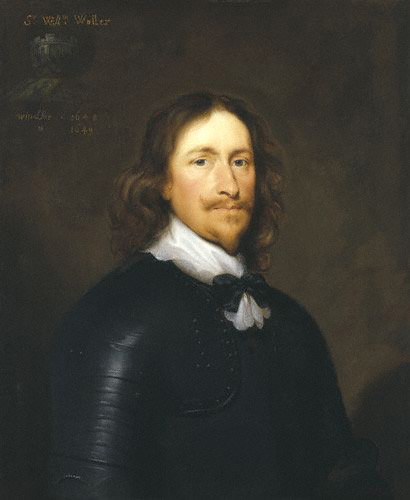
WilliamWaller.jpg 
William Waller


The situation in Kent

Kent was a deeply divided county in the Civil War. Although nominally under Parliamentary control, there were risings in Tonbridge and Sevenoaks in 1643 (see an earlier blog), Canterbury in 1647 and a major uprising in 1648, culminating in the Battle of Maidstone. The Trained Bands however remained firmly in Parliamentary control, even in 1648, and formed part of the Southern Association under Sir William Waller (who was born in Knowle House in Sevenoaks in Kent).

Organisation
 
The Bands were organised into “lathes” or areas, a system unique to Kent and possibly dating to the time when Kent was an independent kingdom1, which might also explain the naming system, as even a cursory glance at a map shows that these are not the most significant places in Kent, and nor were they in the 1640s. Anyway, there were five in total, basically dividing the county north to south. Working from west to east;
Sutton at Hone – adjoining London, including Blackheath, Bromley, Dartford and Westerham
Aylesford – from Chatham and Rochester in the north  to Tonbridge in the south, with the county town, Maidstone.
Scraye – a more rural area, though including Ashford and Faversham. Parts of the Lathe seem to have been strongly Baptist, with in 1670 800 people attending a meeting at Egerton.
St Augustines – Canterbury, and the north Kent ports of Dover, Deal and Sandwich
Shepway – the south Kent ports of Folkestone, Hythe and Romney.

Each area was supposed to supply militia, as well as “auxiliaries” “volunteers” and “Horse”, ie, cavalry.  Note, most of what appears below is from the excellent BCW Project site at www.bcw-project.org.
In 1638 the Kent Trained bands were recorded as having, in total, 4,667 men, with 2,910 muskets and 1,757 corsets (ie. armour for the pikemen) as well as 293 horse. Unfortunately, their equipment was severely criticised just the next year, as many of the muskets didn’t work and the pikes were rotten!

Active history

In 1639 each of the Lathes contributed to a force to be sent north for the ill fated Bishops War in Scotland, 998 men in total. They went by sea, assembling at Gravesend and traveling on naval vessels supplemented with colliers to Harwich where they picked up men from the Essex Trained Bands and sail for Scotland where they were all combined into Sir Thomas Morton’s Regiment of Foot. Perhaps fortunately given the state of their equipment, they were not tested in battle, just occupying the islands of Incholm and Inchkeith, but the regiment did lose 100 men to smallpox.
In 1640 each of the Lathes contributed to a force to be sent north for another “Bishops War” in Scotland, 700 men in total. 

In the Civil War Kent was officially on the Parliamentarian side, with placemen in most of the important positions in the county and the Kent Trained Bands forming part of the Southern Association under Sir William Waller.
Aylesford Lathe  – the Trained Band was initially under Colonel Sir Francis Barnham (the MP for Maidstone) and later Colonel Mark Dixwell, and took part in the Siege Arundel in 1643/4. The Volunteers under Colonel George Newman are recorded at the Second Battle of Newbury in 1643. The Horse may have work blue as they are recorded in 1599 being issued with “cassocks” of this colour.
St Augustine Lathe – under Colonel Sir George Sondes at the start of the war, though he was a Royalist and was later imprisoned and lost much of his estate. He flourished after the restoration and was made Earl of Faversham. His Colonel of Horse, Sir Richard Hardress was initially on the Parliamentarian side and was at the Siege of Arundel, but later he joined the Royalist uprising in 1648. In contrast, the Volunteers were used to put down an uprising in Canterbury in 1647 (their home patch) and one company of the auxiliaries was in garrison in Canterbury in 1648.
Scraye Lathe – under the elderly Sir Edward Hales at the start of the war, the trained band took part in the Siege of Arundel, as did the volunteers under Colonel William Herbert and the Horse. Hale’s grandson was a Royalist and raised a regiment of Horse for the 1648 uprising.
Shepway Lathe – under Colonel Sir Humphrey Hales. The Horse at least were at the siege of Arundel.
Sutton at Hone Lathe – under Sir Francis Walsingham in 1639 and later under Colonel Thomas Blunt. The Volunteers under Colonel Sir William Brooke were at the Relief of Gloucester and later the First Battle of Newbury, in 1643, as well as the Siege of Arundel in 1644. The Horse were initially under Sir John Rivers, though he joined the Royalist uprising at Tonbridge in 1643 (see earlier blog).

1 See www.britishcountyflags.wordpress.com

Sunday, 3 March 2013

Civil War in Kent, 1643

By July 1643 England was 11 months into an increasingly bitter civil war between the supporters of King Charles I (the Royalists), and Parliament (the Roundheads). In some cases this pitched brother against brother, but as a very rough approximation, the cities favoured Parliament, and the countryside the King. This was the case in Kent, mainly Royalist, but next to the huge Roundhead stronghold of London.

Kent was important for three reasons, as a source of Royalist troops, for communications to Dover and the Continent, but also for the Wealden iron working industry. It's hard to see today, but the Weald, an area of about 500 sq miles in Kent and Sussex, was a major source of iron as it had the ore easily available, and trees to provide charcoal. The whole area was dotted with furnaces, and many of the cannon and cannon balls used in the Civil War came from there. The village of Horsemonden, for example, had a furnace employing over 200 men, supplying cannon to the army and navy (and both sides in the Civil War!).

Of course, all this iron had to be moved around, and to get it to London much was shipped along the river Medway. This trade had been become so important that the navigable length of the river had been increased in the 1630s as far as Yalding, although material still had to be transhipped to get past Aylesford bridge downstream. So far therefore the little village of Yalding had mainly experienced the economic benefits of the war - it was about to experience the war at first hand.

The July Expedition into Kent

In July 1643 Parliament in London sent as expedition into Kent, and their report back can be found online at http://yaldinghistory.webplus.net/page38.html .

 Richard Browne (abt 1648)

Approximately 4,000 men, mainly from around Tonbridge, Sevenoaks and Faversham had assembled at Sevenoaks and to quell the "insurrection" London sent 1,800 troops and two troops of Horse, led by Colonel Richard Browne. Even the offical report admits they were joined by few ("but valiant") Gentlemen of Kent. After a failed negotiation at Sevenoaks, the Royalists retreated towards Tonbridge, where on July 24th they made a stand. As the Roundheads approached they found themselves under sniper fire...

"the Londoneres following them; who when they came within two miles of the Towne, heard Muskets goe off, and the bullets flie about their eares, but saw no enemy, for they had hid themselves in the Woods and Hedges, whereupon the Parliament Forces made severall shot at the Woods and Hedges which frighted them away".

The Royalists now formed up in regular formation in front of the town, near Hilden bridge. After they failed to drive them off by cannon fire ("they discharged a little Drake or two, but to little purpose") the Roundheads under Colonel Browne resorted to musket fire, and although it took a "very hot fight", soon the Royalists broke and fled into Tonbridge, where 200 were captured. The rest fled along the line of the Medway to Yalding, pursed by the Parliamentarian cavalry, "and good execution was done upon them".

At Yalding (Yawling in the text) the surviving Royalists, approximately 600 now, again made a stand. The Roundhead commander, Sir Miles Levesey, surveyed the scene and

"drew such forces of horse and foote as he had together, and planting his Ordnance for battering the Towne, drew neere himselfe with his power. His Ordnance were so planted, that hee might have beate the Towne upon the enemies heads, but being unwilling so to doe, if by treaty he could bring them to accord; hee summoned them, promising they should enjoy the benefit of the Parliaments Declaration, if they would submit and lay downe Armes."

Levesey's artillery set up on Burgess Bank, across the river from Yalding church, and despite his claim to have spared the town, at least a few cannon balls have been found in the Royalist positions. Initially the Royalists refused to surrender, but some slipped away as night fell, and next morning Levesey sent a Master Godfery to negotiate. Outgunned, outclassed and outnumbered, 300 of the Royalists fled and the rest surrendered, .

Participants and forces

Parliamentarian

An account from the Parliamentarian tax collector in the area, Thomas Weller of Tonbridge, describing his (very personal!) version of the lead up to the battles here can be found at
http://www.tonbridgehistory.org.uk/events/civil-war.html

The Parliamentary expedition consisted of 1,800 men and two troops of horse. The vast majority of the Parliamentarian troops seem to have been Londoners, probably from the London Trained Bands. Trained Bands were militia, technically part time soldiers, but those from London were some of the best troops available in 1643, well equipped and trained by professional soldiers. With the onset of war 6 regiments had been formed, distinguished by their colour of their flags: Red, White, Yellow, Green, Blue and Orange.

Richard Browne was Colonel of the Dragoons of the London Trained Bands, and senior Captain of the Orange regiment. It seems likely therefore that the troops were at least in part from the Orange regiment, and the Horse were dragoons. The year after the events described here Browne was made Serjeant Major General of the Counties of Oxon, Berks, and Bucks and by 1649 he was Sheriff of the City of London. However, he became disillusioned with Cromwell's Protectorate and he was one of those who welcomed back Charles II, eventually resulting in his being awarded a baronet in 1660.
http://www.british-civil-wars.co.uk/biog/browne.htm

Sir Miles Levesey seems to have been more Kent based. In 1644 he is recorded bringing a regiment of horse from the county to assist the siege of Arundel Castle and in 1648 he won a battle at Kingsdon against the Duke of Buckingham. In 1649 he seems to have been in charge of the forces in Kent, as it was he who was ordered by Parliament to disband most of the military there.

Royalist

Despite the attempts of Weller, especially, to portray the Royalists as bandits, some at least seem to have stood up well to the London Trained bands, and to have been equipped and trained as a proper army. Levesey captured at Yalding..

 "a good quantity of Muskets, gilt Swords, Pistols, Pikes, and Collivers, enough to arme six hundred men, besides seveteene pieces of Ordnance mounted, and as many dismounted, many barrels of Gunpowder, and foote Colours, he tooke one hundred and fifty good horse, besides those conveyed away, but since disclosed."

There seem to have been no cavalry, or if there were, they didn't hang around to protect the army after Tonbridge. There was also no clear commander, which was probably part of the problem. One of those who took part was Thomas Farnaby, scholar and former solider in the Low Countries. He was captured later and imprisoned in Newgate prison, but released in 1645.

This was more or less the end of military activity in Kent in the Civil War, until the great revolt of 1648, but that's another story.