Showing posts with label Gibraltar. Show all posts

Friday, 29 March 2013

British Army commitments, 1842

In 1842 the United Service Magazine of London published a list of the Distribution and Stations of the British Army (available free as a Google ebook). This gives an intriguing snapshot of British military priorities and resources at the time.

British Isles

One thing that's immediately obvious is the worldwide commitment of the army, with only 52 of the 148 regiments listed based in the British Isles. Given the relatively small size of the army compared to her European rivals, this presumably reflects the absence of a clear threat to the homeland, and confidence in the Royal Navy, the “Senior Service” which received more resources, and prestige.
The home forces included all the Guards units, and the bulk of the cavalry.


A Royal Horse Guard in parade dress outside Windsor castle (New York Library digital archive)
Mainland Britain

1st & 2nd Life Guards (Hyde Park & Windsor)
Royal Horse Guards (Regent's Park)
2nd , 3rd and 6th Dragoon Guards (Nottingham, Birmingham & Glasgow)
1st , 2nd, 4th and 6th Dragoons (Manchester, Exeter, Brighton and Piershill)
8th and 11th Hussars (Hounslow & York)
13th Light Dragoons (Ipswich)
17th Lancers (Leeds)

Grenadier Guards (1st ,2nd & 3rd Battalions) (Windsor, Wellington Barracks, London & Winchester)
Coldstream Guards (1st & 2nd Battalions) (St John's Wood & St George's Barracks, London)
Scots Fusilier Guards (1st & 2nd Battalions) (Portman St., and The Tower, London)

6th , 11th, 15th, 16th, 24th, 32nd, 34th, 53rd, 58th, 60th, 61st, 65th, 66th, 67th, 72nd, & 73rd  Regiments of Foot (Gosport, Weedon, Chester, Portsmouth, Devonport, Leeds, Northampton, Edinburgh, Chatham, Manchester, Newcastle, Manchester, Glasgow, Plymouth, Bolton, Newport respectively)

Ireland

4th , 5th & 7th Dragoon Guards (Dublin, Dublin & Cahir)
10th Hussars (Ballincollig)
12th Lancers (Dundalk)

8th , 36th, 37th, 45th (& Reserve Battalion), 54th, 56th, 64th, 69th, & 76th Regiments of Foot

Given Britain's clear dominance of the seas, the Army was deployed either where an invader could come by land, or to protect naval ports. In the first category the two dominant commitments were India and Canada. 

India
The last stand of the 44th (East Essex) on the retreat from Kabul

Twenty nine regiments are based in India, backed up by the massive army of the East India Company. Or rather the three armies of the Presidencies of Bombay, Bengal and Madras. These units comprised mainly local troops with British officers, and were, technically, separate from the British Army as such. Since 1839 the British/ British Indian armies had been locked in the disastrous Afghan War, with in 1842 the massacre on the retreat from Kabul. In total, 4,500 British and Indian soldiers, and 12,000 allied civilians had been killed. In 1845, the British forces would be in action again, this time against the Sikh empire, although this time they emerged (just) victorious.

Bengal

3rd  Dragoons
9th & 16th Lancers

3rd , 9th, 10th, 13th, 21st, 29th, 31st, 44th, 50th, 62nd Regiments of Foot

Bombay

14th Light Dragoons

2nd , 22nd, 28th, 40th, 78th, 86th Regiments of Foot

Madras

15th Hussars

4th , 25th, 39th, 41st, 57th, 63rd, 84th, & 94th  Regiments of Foot

Ceylon

90th & 95th  Regiments of Foot
Ceylon Rifle Regiment

The Americas

After India, the biggest commitment was Canada. War with the United States was regarded as a distinct possibility in 1842, and referred to several times in articles in the magazine. The previous war had ended only 27 years before and there had been several incidents since. In 1837, insurgents had smuggled arms into Canada from the US, only for Canadian militia to cross the border and burn their ship. As recently as 1839 there had been a dispute over the Maine/ New Brunswick border. Whether the force would have been sufficient is debatable, as in the war against Mexico only 6 years later the United States was able to field 32,000 soldiers and 50,000 militia, although of course Britain could have reinforced from the homeland. Having said that, British contingency plans never depended purely on a static defence of Canada and the Royal Navy would have been deployed from it's bases in the Caribbean, especially Bermuda. Hence the deployments throughout the area.

The Canadian deployment had a much lower proportion of cavalry compared to that in India, presumably related to the terrain.

Canada

1st Dragoon Guards
7th Hussars

1st (2nd Battalion), 14th, 23rd, 23rd (Reserve Battalion), 43rd, 68th, 70th, 71st, 71st (Reserve Battalion), 74th, 81st, 83rd, 85th, 89th and 93rd Regiments of Foot

New Brunswick

30th & 52nd Regiments of Foot

Newfoundland

Royal Newfoundland Companies

Nova Scotia

82nd  Regiment of Foot
Rifle Brigade (Reserve Battalion) 
Rifle Brigade (2nd Battalion) 

Bermuda

20th  Regiment of Foot

St Vincent

33rd  Regiment of Foot

Barbados

46th  & 92nd Regiments of Foot

British Guiana

47th  Regiment of Foot (Berbice)
1st West Indian Regiment

Trinidad

59th  Regiment of Foot

Jamaica

60th  Regiment of Foot (2nd Battalion)
2nd West Indian Regiment


The Mediterranean
 
British interests in the Mediterranean centred on her island bases, with the obvious exception of Gibraltar. As well as being a crucial naval base, this had a land border with a Spain that had already coveted Gibraltar for over a hundred years. For much of the 1830s Spain had been racked with civil war (the Carlist Wars) and as recently as 1842 there had been a coup attempt in Madrid. In the circumstances it is hardly surprising that Gibraltar was strongly garrisoned.

The forces in Corfu, Cephalonia, Zante and the Ionian Islands perhaps require some explaining. These had been Venetian possessions before conquered by France during the Napoleonic Wars, Several rapid changes of ownership followed before they became a British protectorate at the Congress of Vienna. British rule was certainly hugely better than French or Venetian, but after Greek independence in 1830 a movement developed to join the mainland, which they eventually did in 1864. A this time Corfu, especially, was a very useful British naval base in the eastern Mediterranean, especially for British intervention in the short Egyptian/ Ottoman war in 1839-41.

Gibraltar

1st (1st Battalion), 5th, 7th, 48th & 79th Regiments of Foot

Malta

19th and 88th Regiments of Foot
Rifle Brigade (1st Battalion)
Royal Malta Regiment

Corfu

38th, 77th and 97th  Regiments of Foot ( 97th Reserve Battalion)

Cephalonia

42nd  Regiment of Foot

Ionian islands

42nd  Regiment of Foot (Reserve Battalion)

Zante

97th  Regiment of Foot

Africa

Mauritius

12th , 35th and 87th Regiments of Foot

Sierra Leone

3rd West Indian Regiment

South Africa (Cape of Good Hope)

27th , 75th, 91st (& Reserve Battalion) Regiments of Foot
Cape Mounted Riflemen (Cape of Good Hope)

St Helena

St Helena Regiment

The Far East

The 18th (Royal Irish) at the Battle of Amoy in China, 1841

The large garrison in China was a result of the Opium war, which had started in 1839, and only ended in 1842. Since the 1750s a massive amount of tea and other goods had been imported to Britain from China, but access to Chinese markets in return was extremely restricted, creating a huge trade imbalance (sound familiar?). The unfortunate British response was to export opium, for which there was a huge Chinese market. Initially this was actually welcomed by the Chinese government (as long as they got their cut via taxes), but the massive increase in opium production and importation led to increased tensions and eventually war, which the British won easily, gaining Hong Kong as a colony. All this, of course, required British troops.

Otherwise, the largest British deployment was in New South Wales. This does not necessarily mean Australia, and in fact probably doesn't. In 1840, New Zealand had controversially become a British territory, initially assigned to New South Wales and in 1841 becoming a separate colony, but possibly that change is not reflected in this list. Certainly annexation had been far from popular with some of the Maori chieftains, though others had argued that too many European settlers had been let in previously, and New Zealand was inevitably going to be  British or French. Anyway, small scale revolts and skirmishes started almost immediately, and resulted in two major British-Maori wars in the 1860s.

Aden

17th  Regiment of Foot

China

18th , 26th, 49th, 55th and 98th Regiments of Foot

New South Wales

51st , 80th, 96th & 99th Regiments of Foot


Monday, 16 July 2012

The Spanish at the Gates, Gibraltar 1779-1783

It's very hard to get details of the Spanish troops involved in the Siege, after all the the British concentrated on the heroics of the garrison, and the Spanish didn't like to dwell on a major defeat. But it was an immense deployment. Fortunately, there is an excellent study by Ángel J. Sáez Rodríguez of the Instituto de Estudios Campogibraltareños online - Uniformes y ejercitos multinacionales en El Gran Asedio de Gibraltar (1779-1783).

The Army

The infantry troops of the Spanish army who participated at some point in the siege included four battalions of Spanish Guards and another four of Walloon Guards, the first battalion of the Regiment of America, one battalion each of the Regiments of Cordoba and Savoy, and the regiments of Zamora, Extremadura, Guadalajara, Murcia, Princesss and Burgos. Of these, some were composed of hardened troops, like those from the recent campaigns in Uruguay such as the Regiments of Murcia, la Princessa, Cordoba, Zamora, Guadalajara, Saboya and the Lusitania Dragoons, whilst others had no experience at all. Amongst the foreign units were the Regiment of Ulster, the Italians of Milan and Naples, and the Swiss Betchart Regiment.

 A grenadier from the Napoles Regiment

For many years enlistment in the army had been voluntary, backed up by foreign mercenary forces, which is why there were so many Irish and Swiss regiments. There was a prohibition on recruiting non-Catholics, so there not the German troops found in British and French armies. But increasingly an important part of the Spanish forces were the provincial militia, with over a third of the 42 Regiments serving at Gibraltar at one time or another. According to the Ordinance of 1770 males over 1.6m and between 18 and 36 were liable and each province had to provide a quota, though there were many exceptions by profession, and especially by social class. Service was for 8 years, and each regiment  was commanded by a colonel, with 8 companies of infantry, one of grenadiers and one of light infantry. At Gibraltar the grenadiers and light infantry were separated and formed into 3 divisions including the provincial grenadiers of Andalusia, Ciudad Real, Guadix, Logroño and Toro, and provincial light infantry of Jerez, Lorca and Soria.
 A captain in the America Regiment

Regarding the cavalry, the majority of regiments were represented at one time or another. There was a clear distinction between the "cavalry" and dragoons.  Among the former,  were 2 squadrons of the Bourbon Regiment and the Alcantara, Algarve, Calatrava, Farnese Infante, Montesa. Also present were Volunteer Cavalry, as a squadron of this unit of light cavalry. With the reforms of Charles III, the cavalry regiments of the line at this time included 4 squadrons, and each of these, 3 companies, totalling 504 men.

 The Farnesia, Alcantara and Principe Regiments. The drummer of the Alcantara Regiment is wearing a different uniform to the bulk of the regiment, as per the infantry.

Among the dragons were 2 squadrons of the Pavia and Lusitania Regiments and the Almansa, King, Sagunto, Villaviciosa Regiments  These were sometimes used to fight dismounted as light infantry. Since 1768, the dragoon regiments consisted of four squadrons, each composed of three companies formed by a captain, one lieutenant, one lieutenant, two sergeants, drummer, four corporals, four grenadiers and 32 dragons, as well as the staff.

The usual deployment of the blockading forces was organised as follows. The far right of the line was occupied by the Spanish Guards, the far left by the Walloon Guards and the center by other line infantry regiments.The outposts of the isthmus were occupied by the light infantry regiments of the Volunteers from Catalonia and Aragon. These had a leading role in the skirmishes at the advanced trenches on the isthmus, contesting control of no man's land, both to prevent enemy infiltration and to intercept the flight of deserters. Given that, in the end, no attempt was made to storm Gibraltar, it was these troops at the front line who saw the only actual fighting, with the sappers and artillery. They were at constant danger from sniper and artillery fire, the height of the Rock giving the besieged a great advantage. This danger got considerably worse when the British started to shorten the fuses of their mortar shells, so that instead of burying into the sandy soil the shells exploded early, an early form of airburst effect.

 Voluntario de Catalunya 1778

Uniforms

Ironically the Spanish Army showed more variation in colour than the combined British and Hanoverians, with white, blue, red and yellow uniforms. Trousers were of the same colour as the coats.The basic colour of the infantry was supposed to be white, following an edict from Philip V, with fifes and drums in blue.  But of the regular infantry, only 32  of the 52 regiments wore white coats at this time.
The militia also wore white, with blue and purple facings.  "White" was a relative term though, as each man had only one uniform, which had to last several years, and so it was often patched and dirty. But there were also regiments with blue coats, especially the Guards, or red (the irony of the Irish having the same uniform as their hated enemies the English did not go unremarked) and the Dragoons, uniquely, wore yellow. Add the blue of the artillery and navy, both important at Gibraltar, and you have quite a mixture.
 The infantry were in the process of changing their tricornes to leather caps with brass badges, but the grenadiers retained their distinctive bearskins.

  The artillery and Corps of Engineers both used a loose blue uniform with scarlet facings and they kept the tricorne which was being phased out of the other services. Although the commander of the Spanish forces at Gibraltar was completely useless, described as a "null" by the French, other commanders performed well, and the men bravely. Like the artillery, the uniform was of blue, with red facings.

Saturday, 14 July 2012

Hanoverians at the Siege - Gibraltar 1779-83

Extracted from "Geschichte de churhannoverschen Truppen in Gibraltar, Minorca und Ostindien" by Ernst von dem Knesebeck, published in 1845. Available as a google ebook.

To Gibraltar

August de la Motte, the senior Hanoverian commander during the Siege

It soon became clear in 1775 that Britain did not have enough troops to calm the colonial rebellion in America. So the English parliament approached George III, who was also king of Hanover, and they requested the use of Hanoverian troops. He agreed and wrote to Field Marshal von Spoercken to release five battalions. These would be paid by the English, but were only be available for use in Europe, and would be subject to their own rules, justice and religion. The idea was that they could release British garrison troops for the Americas. Two battalions were sent to the island of Minorca, then British, and three to Gibraltar.

das 1. Bataillon von Reden, under Obristlieutenant von Walthausen; replaced by von Dachenhausen when von Walthausen drowned in November 1775

das 1. Bataillon von Hardenberg, later known as von Sydow, under Obristlieutenant von dem Bussche. Von dem Bussche returned to Hannover in 1778 and was replaced by von Hugo.

das 1. Bataillon la Motte, under Obristen la Motte and Major von Schlepegrell.

Each battalion consisted of one grenadier and five musketeer companies, with a total including officers and noncommissioned officers of 473 men, as well as two women. The red and white uniform was remarkably similar to the British troops, though Hanoverian officers wore a characteristic gold sash.

 Gustav Von Dachenhausen

By November 1775 they had been shipped down to Gibraltar, where they were heartily welcomed by the Vice-Governor, Major-General Boyd, and shown to their barracks in the city. The three English regiments that the Hanoverians were replacing were reportedly not best pleased to be leaving for the forests of America, and the Hanoverians soon discovered why. Gibraltar at this time was a very congenial posting, the southern climate was comfortable, the food good, and the Rock interesting. Although most days, after service, the troops were put to work on the fortifications they received a working grant, and most considered themselves well paid.

"Many a trip was undertaken by the Hanoverian officers after the Spanish cities in the area, even to Italy, Africa and the African pirate states. In the fortress were the hospitable rooms of the vice-governor of officers to open once a week, and also to the other days there was no lack of social conversations. The arrival of the first governor (General Elliot) in no way interfered with these pleasant conditions, and soon did this great man's love and respect for the Hanoverian brigade just to win as much as had been both the General Boyd."

Start of the Siege - 1779-1780

Governor Elliot was expecting trouble, but a sudden declaration of war in 1779 took him by surprise. Several officers from the garrison were vacationing in Spain, and one was taken prisoner. The Spanish, based in a camp at San Roque, consisted of 18 battalions of infantry, one battalion of artillery, eight squadrons of cavalry and 4 squadrons of dragoons. At the same time the Bay of Gibraltar was blockaded by a Spanish fleet of three battleships, three frigates and nine smaller vessels. In comparison, the garrison of Gibraltar, had 5 English and 3 Hanoverian battalions, which including the artillery reached a strength of almost 5,400 men. There was also a volunteer corps of Englishmen and Germans, with 2 officers and 80 privates, under Lieutenant Belleville of the La Motte regiment. They had in the harbour one ship of the line, of 60 guns, and three smaller ships.

From July 1779 to mid-January 1780 only 15, mostly in small boats made it past the blockade with food, and lack of meat and fresh food became a  real issue. An armed guard had to be put on the bakers, so great was the demand. The weekly ration of a soldier consisted of 7 pounds of wheat bread or hardtack, 2 pounds of salted beef and 1 pound of salt pork, 4 pints of peas, 3 of oatmeal and 10 ounces of butter. The latter was later withdrawn and replaced by more oatmeal. On 11th January 1780 even this was reduced, with the loss of the pork and one pound of beef. Apart from this though, service in the fortress was not too severe and the health of the soldiers was pretty good. At any one time only 600 out of 6,000 were needed for piquet duty, and time hung heavy for the rest. They were also well protected from enemy fire, only 30 men were lost from the three Hanoverian battalions in 1780.

On the night of 30 September 1st October 1780 the Spanish made a raid on the palisades of the Bay side and caused some damage, but worse was prevented by the "vigilance and intrepidity of two Hanoverian soldiers who were here on duty".

1781 - the counter attack

The relief convoy in April 1781 was a huge relief, with massive celebrations all round, and in fact quite a lot of drunkenness until order was restored. The downside was a huge increase in Spanish bombardment, first against the transports and then against the town. 25 Hanoverians were wounded, and 156 in the garrison as a whole. Monotony was replaced by labour as the bastions were continually repaired, and new ones cut from the rock.

Throughout the autumn work continued on the Spanish side, building more and more batteries, and it was clear that something had to be done. In secret, General Elliot started planning a sortie. He was helped when on 20th November two Spanish deserters arrived, and could give detailed plans of the batteries and their layout. They also described Spanish morale as very low, and the state of things on general to be sloppy. On the night of the 26th November 1781, the British attacked,. It was an incredibly risky operation. They had to cover 500 yards to the Spanish lines, and then another 1,000 to the batteries and there was only one exit, and entry, gate. They were organised into three columns, with Hanoverian troops forming the bulk of the right hand column under von Hugo. This consisted of the von Hardenberg regiment (296 men), together with the grenadier companies of the von Reden and la Motte Regiments (142), the light company of the British 56th Regiment (57) together with 25 artillery men and 50 labourers, 570 in total. The right column was to attack the San Carlos battery on the east of the Spanish lines. The British troops in the centre column were under the Hanoverian Dachenhausen.

 Senior allied officers during the sortie, with Gibraltar behind

At midnight the troops were gathered, and 3 clock in the morning on 27 November, after the moon, which shone very bright, had set, they left Gibralltar. In the darkness they came first across the Spanish Walloon Guard, and upon being challenged Lieutenant Hugo shouted "Krena6iers ällsnovre! " and they rushed the 7ft high barricade with little resistance. A portion of the Hardenberg Regiment had strayed in the darkness and came upon the San Carlos battery unexpectedly, from where they received a volley but they carried on, reinforced by the rest of the Regiment, and this was the only mistake of the night. At a given signal the batteries in Gibraltar opened up and the Spanish, thrown into confusion, retired from the battery line. With incredible speed troops swarmed over the batteries and fascines, attaching wreathes of pitch which they set alight, and spiking the guns. They were covered from counter attack by the combined light and grenadier companies and the Hardenberg Regiment. When trails of powder were lit to the magazines, the order was given to withdraw, again covered by the Hardenberg Regiment, with the magazine exploding like an earthquake before they reached the gate. By 5 o clock they were inside.

The sortie had been incredibly successful, the siege works burned for days and several magazines had been lost, all for remarkably little loss. Of the Hanoverians, the Hardenberg Reigment lost 2 dead and one wounded, von Reden 1 dead, and la Motte escaped casualties.

One consequence of the sallie was increased public perception in England, especially at a time of almost unrelenting bad news. George III, as Hanoverian head of state, promoted La Motte to Lieutenant Genral, and von Hugo and von Dachenhausen to Colonel & Brigadier.

The Spanish now turned their fire again on the city, and much of it was destroyed, though the fortifications were almost untouched. There were again few casualties, though several men from La Motte were lost when one of the magazine at the Willis batteries received a direct hit and exploded. But conditions on the Rock were now worse than ever, the troops sleeping in tents, many of the non-combatants in whatever ruins or huts they could find. There was plenty of salt beef, but no fresh food, and scurvy broke out again.

1782-4 - the Grand Bombardment and home.

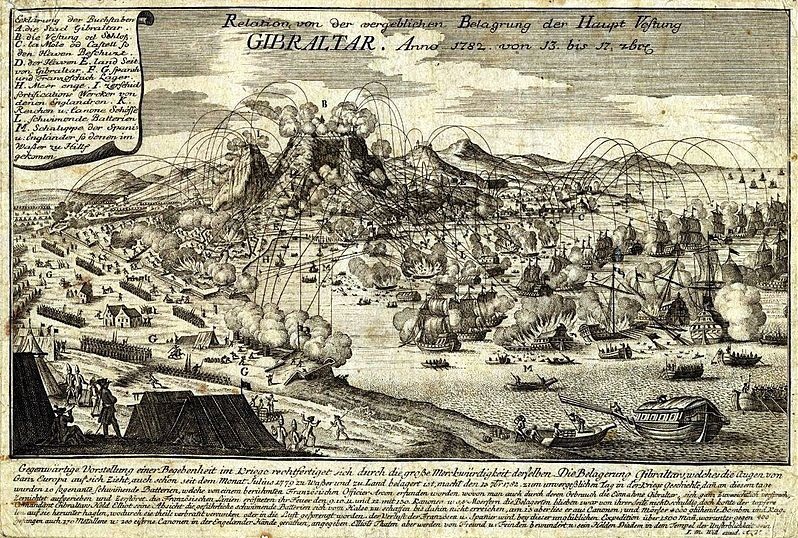
A German (Hanoverian?) portrayal of the bombardment

During the early months of 1782 the Spanish reconstructed their earthworks, with no expense being spared, and of course, defences much improved. They also considered what new methods they could use, even poison gas, but they decided to build floating batteries, and this went ahead in great secrecy. Meanwhile, the British and Hanoverians had been strenghtened to 7,500 men, and were making innovations of their own, including a cannon which could be depressed 20 degrees, for firing from the great height of the Rock. They also developed "heated shot". Actually, this wasn't new, but was hardly ever used as it was technically very difficult, the heat tending to ignite the powder of the cannon prematurely. But they had lots of cannons, and time, to play with and eventually got it right. A sergeant in the La Motte Regiment, Schwependik, a blacksmith by trade, invented an oven that could produce several glowing shot at once. He received a life long pension from the English government.

The Spanish also built up their assault forces, under the command of the Duke of Crillon, who had just captured the island of Minorca, and the Hannoverian garrison there. There was also a French corps under Falkenhayn of 4,000 men, which although small in comparison to the Spanish forces, almost matched the garrison by itself. There were many more cannon, more ships, and the floating batteries. There were also landing craft, flat bottomed to convey troops across the bay after the defences had been pounded to rubble. It looked like this time the Spanish could not possibly fail.

On 9th September 1782 all the land batteries and gun boats started firing, joined on the 12th by a Franco Spanish fleet, and on the 13th by the floating batteries, which were meant to bear the brunt of the attack. The British responded by the heaviest fire they could manage, concentrated initially on the boats towing the floating batteries, which were crewed by criminals as the work was so obviously dangerous. To their dismay the British found that the floating batteries themselves were more or less immune to cannon fire. Only the heated shot seemed to make any impression, and even then the artillery battle went on for hours. By 3pm smoke was blowing around the bay, but it was not until 8pm that the garrison could see boats evacuating crews from the floating batteries. By 11pm a shipwrecked Spanish ship bought news that the Spanish were starting to retire, but still the battle kept on, artillery crews replaced with sailors who knew how to work the guns. By 3am several floating batteries could be seen in flames, which only served to illuminate the others to make better targets. Before daybreak a counterattack with gunboats drove off the boats protecting the batteries and the danger was over. Overall, Spanish losses were estimated at about 2,000, losses in the garrison were just 16 killed and 69 wounded.

Although moral in the siege lines was now low, the Spanish court did not give up, and the blockade continued. Fresh food was still low. The arrival of Howe's convoy in October relieved matters though, and brought the garrison up to 8,000 men. Spanish preparations for another attack continues, but halfheartedly, and in February 1783 news came of the Treaty of Versailles. On March 12th Governor Elloit met the Duke of Crillon outside the walls, they shook hands and peace was declared.

It was over a year before the Hanoverian brigade could return home, but in August 1784 they embarked and in September they were back in the river Weser at Geestendorf (Bremerhaven). They were met by Major Genreral von Busse and one by one discharged from English service. They marched to their respective garrisons at Nienburg, Verden and Hameln, where they were received as heroes.

As an aside, the three Hanoverian Regiments were granted the battle honour "Gibraltar". Their successors in the German Army still carried this into World War 1.

Wednesday, 11 July 2012

The Largest Battle of the American Revolution

Was this Saratoga? Yorktown? No, it was the siege of Gibraltar, empathising how world wide this conflict really was.

The Siege

Gibraltar ("The Rock") had been ceded to Britain in the Treaty of Utrecht in 1713, ""for ever, without any exception or impediment whatsoever", but Spain had been trying to renege on the treaty ever since. In 1779, with Britain alone against Spain, France, Holland and revolting American colonists, the opportunity seemed to there for the taking.

Spain laid siege with 13,000 men under Martín Álvarez de Sotomayor, including two battalions each of Royal Guards and Walloon Guards of the Spanish army, whilst the cavalry included French Dragoons. There was also a blockade on the seaward side, based at Algiciras, and another Spanish squadron at Cadiz to block reinforcements.

The British, under Governor General Elliot, had 5,382 troops including a Corsican contingent and a Hanoverian Brigade of three battalions. Fortunately, Elliot turned out to be an inspiring and determined leader. And a conscientious one, he had been laying in stores and preparing defences for some time.


The Defences

The only landward route to Gibraltar was, and is, across a narrow isthmus. Every effort had been made to cover this with as many cannon as possible. Directly across the causeway was a wall and dry ditch with two bastions, mounting 26 guns. Flanking this, and the causeway itself were the King's, Queen's, and Prince's lines cut out of the rock itself. Above were the Willis batteries, and then further batteries up the Rock until the summit, which was crowned with cannon and mortars. The Mole, projecting out past the harbour, was itself fortified and gave a crossfire onto the causeway. There was so much artillery that 100 British infantry were detailed to help man the cannons. The whole was so formidable that it was called the Mouth of Fire by the Spanish. The seaward side was equally covered with bastions and cannon from sea level to the summit, with barriers of old masts and chains blocking the old and new landing stages. Only the Eastern flank, which is a sheer drop into the sea, was unfortified and left to the famous Gibraltar apes. Last, but not least, a huge cistern had been made to collect rain water, so that at no point in the siege was there a shortage of water.

The Spanish troops constructed huge siege works around Gibraltar, and the blockade started to bite. By the winter Gibraltar, with virtually no room to grow food, was starting to suffer. Scurvy, caused by a shortage of fresh vegetables, was common and ships had to be broken up to get firewood. What saved Gibraltar was the Battle of Cape Vincent in January 1780, A massive British convoy under Admiral Rodney not only smashed through the Spanish blocking force at Cadiz, but captured or destroyed 4 ships of the line, including the Spanish flagship. This, the supplies landed, and reinforcement with the 73rd Highlanders gave a huge boost to the garrison morale. The presence of Prince William, son of the King, in the fleet also showed commitment from Britain, and that the garrison was not forgotten.

 The Battle of Cape St. Vincent

Running the Blockade

By the summer of 1780 food was running low again, but blockade runners kept them going. Every effort was made to bring in fresh fruit from Africa to hold off scurvy.

Admiralty-Office, September. 18, 1781.
Extract of a Letter from Captain Curtis dated Brilliant, Gibraltar, August 7.
I beg Leave to acquaint My Lords Commissioners that His Majesty's Sloop Helena arrived here this Morning. Her Approach was discovered by the Enemy and us at the same Time, about Five o'Clock. She was in the Gut to the Southward of Cabarita Point, and nearly a Third of the Way over from it towards Europa. It was perfectly calm, and the Helena was rowing for the Rock.

I immediately took the Repulse and Vanguard Gun-Boats, with all the Boats of the Ships; and went for her, as expeditiously as possible. Fourteen Gun-Boats of the Enemy, carrying each One Twenty-six Pounder in the Bow,, moved also from Algaziras, accompanied by several Launcbes. These Boats got on faster than I could proceed with the Repulse and Vanguard, and before Eight o'Clock those of them the most advanced commenced their Fire upon the Helena, being then within Half Gun-shot. She returned it with great Deliberation and Effect, but still continuing to use her Oars. The greater Part of the Gun-Boats were soon close to her, and the Clouds of Grape and other Shot, that seemed almost to bury her were really astonishing. However she could not, without our Aid, bear long this very unequal Combat. The Repulse and Vanguard began a well-directed Fire upon the Enemy, being so placed as was deemed the most efficacious to cover the Helena, and annoy them. 

The commencement of the Sea Breeze having got to the Helena she soon reached us, the Enemy still persevering on their attempt upon her, firing at her broadside and others keeping astern, raking her. However the Steadiness and Bravery exhibited onboad the Helena, and the well appointed Grape from the Repluse and Vanguard, very soon made some of them retire, and they had all fled by ten o Clock, allowing us to tow the Helena into the Mole without further molestation. A Xebec, mounting between twenty and thirty guns, which was lying near to Cabarita Point, got under way when the Breeze came and advanced to join the Gun Boats, but upon seeing them retire she retired also.

The Masts, Sails, Rigging and Furniture of the Helena are cut all to Pieces, and the Hull a good deal damaged, but it is as wonderful as it is fortunate that the Boatswain was the only man who was killed on board her.  The Bravery, the Coolness, and the Judicious Conduct of Captain Roberts do him infinite Honour and His Officers and Men deserve the highest Commendation.
London Gazette

On 7th June the Spanish sent a fire ship into the harbour. This nearly worked, but the garrison was alerted and at 1am woke to see Gibraltar blood red against the dark night. Cannonades drove off the Spanish boats, and English boats rowed out, hooked the burning vessel, and towed it away. Even then the danger was not over, two more fireships were approaching and almost reaching the pier, but they were fended off just in time. The hulks were later salvaged by the British and used, ironically, as firewood

Yet again food started to run out, especially as supplies from North Africa had been cut, but another convoy arrived in April 1781, and this convoy evacuated all civilians from the Rock.

The Sortie and the Grand Bombardment

It was now clear to the Spanish and French that the British could not be starved out. So in November they assembled ready to storm the defences. the British response took them entirely by surprise. The night before the assault was due fully half the garrison silently left Gibraltar and then flung themselves on the siege lines. It was a dramatic success, batteries were set on fire, cannon spiked and troops routed. Over two million pounds worth of Spanish stores and equipment, an immense sum for the time, was destroyed. the assault had to be cancelled.

 Watching the destruction of the Spanish floating batteries from The Rock

But still the Spanish and French persisted. Eventually, on 13 September 1782, nearly three years after the siege started, they started their assault. The plan was to smash Gibraltar´s defences "into powder" and then storm it with 35,000 Spanish and French troops. A fleet of 18 ships of the line, 40 gunboats and 20 bomb vessels surrounded the Rock, as well ten "floating batteries" with 138 heavy guns. These were immense, with guns only on one side, counterbalanced with lead. The cannon side had extra protection, and a roof was made of planks and iron sheets. They were, in a way, the first Ironclads. On the landward side there were 86 more guns. Over 80,000 spectators gathered to watch the show - they were disappointed. The British batteries, with higher elevation, and therefore range, fired red hot shot at the wooden floating batteries, exploding three and damaging the rest. They also damaged the ships so much that they caused 719 casualties. Demoralised, the allies withdrew.

This was the last major assault. In October another large British convoy appeared, 31 transports with supplies and the 25th, 59th and 79th regiments. The siege continued but in February 1783 a peace treaty was signed. Although the British bargaining position was weak the Spanish didn´t press for Gibraltar, gaining instead Minorca and territory in the Americas. Presumably they assumed Gibraltar could be picked off at a later date. It wasn´t.