Showing posts with label China. Show all posts

Friday, 29 March 2013

British Army commitments, 1842

In 1842 the United Service Magazine of London published a list of the Distribution and Stations of the British Army (available free as a Google ebook). This gives an intriguing snapshot of British military priorities and resources at the time.

British Isles

One thing that's immediately obvious is the worldwide commitment of the army, with only 52 of the 148 regiments listed based in the British Isles. Given the relatively small size of the army compared to her European rivals, this presumably reflects the absence of a clear threat to the homeland, and confidence in the Royal Navy, the “Senior Service” which received more resources, and prestige.
The home forces included all the Guards units, and the bulk of the cavalry.


A Royal Horse Guard in parade dress outside Windsor castle (New York Library digital archive)
Mainland Britain

1st & 2nd Life Guards (Hyde Park & Windsor)
Royal Horse Guards (Regent's Park)
2nd , 3rd and 6th Dragoon Guards (Nottingham, Birmingham & Glasgow)
1st , 2nd, 4th and 6th Dragoons (Manchester, Exeter, Brighton and Piershill)
8th and 11th Hussars (Hounslow & York)
13th Light Dragoons (Ipswich)
17th Lancers (Leeds)

Grenadier Guards (1st ,2nd & 3rd Battalions) (Windsor, Wellington Barracks, London & Winchester)
Coldstream Guards (1st & 2nd Battalions) (St John's Wood & St George's Barracks, London)
Scots Fusilier Guards (1st & 2nd Battalions) (Portman St., and The Tower, London)

6th , 11th, 15th, 16th, 24th, 32nd, 34th, 53rd, 58th, 60th, 61st, 65th, 66th, 67th, 72nd, & 73rd  Regiments of Foot (Gosport, Weedon, Chester, Portsmouth, Devonport, Leeds, Northampton, Edinburgh, Chatham, Manchester, Newcastle, Manchester, Glasgow, Plymouth, Bolton, Newport respectively)

Ireland

4th , 5th & 7th Dragoon Guards (Dublin, Dublin & Cahir)
10th Hussars (Ballincollig)
12th Lancers (Dundalk)

8th , 36th, 37th, 45th (& Reserve Battalion), 54th, 56th, 64th, 69th, & 76th Regiments of Foot

Given Britain's clear dominance of the seas, the Army was deployed either where an invader could come by land, or to protect naval ports. In the first category the two dominant commitments were India and Canada. 

India
The last stand of the 44th (East Essex) on the retreat from Kabul

Twenty nine regiments are based in India, backed up by the massive army of the East India Company. Or rather the three armies of the Presidencies of Bombay, Bengal and Madras. These units comprised mainly local troops with British officers, and were, technically, separate from the British Army as such. Since 1839 the British/ British Indian armies had been locked in the disastrous Afghan War, with in 1842 the massacre on the retreat from Kabul. In total, 4,500 British and Indian soldiers, and 12,000 allied civilians had been killed. In 1845, the British forces would be in action again, this time against the Sikh empire, although this time they emerged (just) victorious.

Bengal

3rd  Dragoons
9th & 16th Lancers

3rd , 9th, 10th, 13th, 21st, 29th, 31st, 44th, 50th, 62nd Regiments of Foot

Bombay

14th Light Dragoons

2nd , 22nd, 28th, 40th, 78th, 86th Regiments of Foot

Madras

15th Hussars

4th , 25th, 39th, 41st, 57th, 63rd, 84th, & 94th  Regiments of Foot

Ceylon

90th & 95th  Regiments of Foot
Ceylon Rifle Regiment

The Americas

After India, the biggest commitment was Canada. War with the United States was regarded as a distinct possibility in 1842, and referred to several times in articles in the magazine. The previous war had ended only 27 years before and there had been several incidents since. In 1837, insurgents had smuggled arms into Canada from the US, only for Canadian militia to cross the border and burn their ship. As recently as 1839 there had been a dispute over the Maine/ New Brunswick border. Whether the force would have been sufficient is debatable, as in the war against Mexico only 6 years later the United States was able to field 32,000 soldiers and 50,000 militia, although of course Britain could have reinforced from the homeland. Having said that, British contingency plans never depended purely on a static defence of Canada and the Royal Navy would have been deployed from it's bases in the Caribbean, especially Bermuda. Hence the deployments throughout the area.

The Canadian deployment had a much lower proportion of cavalry compared to that in India, presumably related to the terrain.

Canada

1st Dragoon Guards
7th Hussars

1st (2nd Battalion), 14th, 23rd, 23rd (Reserve Battalion), 43rd, 68th, 70th, 71st, 71st (Reserve Battalion), 74th, 81st, 83rd, 85th, 89th and 93rd Regiments of Foot

New Brunswick

30th & 52nd Regiments of Foot

Newfoundland

Royal Newfoundland Companies

Nova Scotia

82nd  Regiment of Foot
Rifle Brigade (Reserve Battalion) 
Rifle Brigade (2nd Battalion) 

Bermuda

20th  Regiment of Foot

St Vincent

33rd  Regiment of Foot

Barbados

46th  & 92nd Regiments of Foot

British Guiana

47th  Regiment of Foot (Berbice)
1st West Indian Regiment

Trinidad

59th  Regiment of Foot

Jamaica

60th  Regiment of Foot (2nd Battalion)
2nd West Indian Regiment


The Mediterranean
 
British interests in the Mediterranean centred on her island bases, with the obvious exception of Gibraltar. As well as being a crucial naval base, this had a land border with a Spain that had already coveted Gibraltar for over a hundred years. For much of the 1830s Spain had been racked with civil war (the Carlist Wars) and as recently as 1842 there had been a coup attempt in Madrid. In the circumstances it is hardly surprising that Gibraltar was strongly garrisoned.

The forces in Corfu, Cephalonia, Zante and the Ionian Islands perhaps require some explaining. These had been Venetian possessions before conquered by France during the Napoleonic Wars, Several rapid changes of ownership followed before they became a British protectorate at the Congress of Vienna. British rule was certainly hugely better than French or Venetian, but after Greek independence in 1830 a movement developed to join the mainland, which they eventually did in 1864. A this time Corfu, especially, was a very useful British naval base in the eastern Mediterranean, especially for British intervention in the short Egyptian/ Ottoman war in 1839-41.

Gibraltar

1st (1st Battalion), 5th, 7th, 48th & 79th Regiments of Foot

Malta

19th and 88th Regiments of Foot
Rifle Brigade (1st Battalion)
Royal Malta Regiment

Corfu

38th, 77th and 97th  Regiments of Foot ( 97th Reserve Battalion)

Cephalonia

42nd  Regiment of Foot

Ionian islands

42nd  Regiment of Foot (Reserve Battalion)

Zante

97th  Regiment of Foot

Africa

Mauritius

12th , 35th and 87th Regiments of Foot

Sierra Leone

3rd West Indian Regiment

South Africa (Cape of Good Hope)

27th , 75th, 91st (& Reserve Battalion) Regiments of Foot
Cape Mounted Riflemen (Cape of Good Hope)

St Helena

St Helena Regiment

The Far East

The 18th (Royal Irish) at the Battle of Amoy in China, 1841

The large garrison in China was a result of the Opium war, which had started in 1839, and only ended in 1842. Since the 1750s a massive amount of tea and other goods had been imported to Britain from China, but access to Chinese markets in return was extremely restricted, creating a huge trade imbalance (sound familiar?). The unfortunate British response was to export opium, for which there was a huge Chinese market. Initially this was actually welcomed by the Chinese government (as long as they got their cut via taxes), but the massive increase in opium production and importation led to increased tensions and eventually war, which the British won easily, gaining Hong Kong as a colony. All this, of course, required British troops.

Otherwise, the largest British deployment was in New South Wales. This does not necessarily mean Australia, and in fact probably doesn't. In 1840, New Zealand had controversially become a British territory, initially assigned to New South Wales and in 1841 becoming a separate colony, but possibly that change is not reflected in this list. Certainly annexation had been far from popular with some of the Maori chieftains, though others had argued that too many European settlers had been let in previously, and New Zealand was inevitably going to be  British or French. Anyway, small scale revolts and skirmishes started almost immediately, and resulted in two major British-Maori wars in the 1860s.

Aden

17th  Regiment of Foot

China

18th , 26th, 49th, 55th and 98th Regiments of Foot

New South Wales

51st , 80th, 96th & 99th Regiments of Foot


Friday, 31 August 2012

Austrians & Boxers 1900, Part 3


Introduction

In 1900, China was teetering on the edge of being a "failed state". A huge rural rebellion, known in the West as the "Boxer" rebellion, was sweeping the country, ostensibly against foreigners and Christians, the latter being murdered in large numbers. The weak Imperial government, unsure whether to utilise, or stamp on, the Boxers gave them free reign, so much so that by 1900 the foreign embassies, or "Legations" in Peking were under siege. Fortunately, enough sailors and marines had been scrapped together from foreign warships on the coast to give the bare minimum of defence. There were British, Russians, French and Japanese, but this is the story of the Austrians, with details form Indiscreet Letters from Peking by B.L. Putnam Weale.

SMS Zenta in 1900

The only Austro-Hungarian force available to go to the aid of their legation was from the cruiser SMS Zenta. Consequently, Captain Thormann with several of his officers, 30 men and a machine gun made their way to Peking, where they were trapped in the Siege. Their adventures up to this point are described here and here. We take up the story on the 10th of July.

10th July

Putnam Weale details the various "artillery" available to the defenders. He is not impressed. After the Italian one-pounder ("absolutely useless", "merely a plaything") he describes the Maxim machine gun the Austrians had bought from SMS Zenta...

" a very modern weapon, and throws Mannlicher bullets at the rate of six hundred to  the minute. Yet it, too, is practically useless. It has been tried everywhere and found to be defective. When it rattles at full speed, it has been seen that its sighting is illusory, that it throws erratically high in the air, and that ammunition is simply wasted. It cannot help us in the slightest. The value of machine-guns has been always overrated. "

This was together with a British Nordenfeldt ("absolutely useless and now refuses to work") and an American Colt ("so small, being single-barrelled, that it can only do boy's work. Yet this Colt is the most satisfactory of all, and when we have dragged it out with us and played it on the enemy, it has shot true and straight They say it has killed more men than all the rest put together").
There should have been a Russian field gun, but although 1,000 shells were bought, the gun itself was somehow left in Tientsin Station. Putnam Weale suspects that there had been a deal done between the Chinese and Russian that the Russian legation would not be attacked.

13th July

 Austro-Hungarian naval officers in China

The Chinese exploded a huge mine under the defences, burying the French Commander, the Austrian Charge d'Afaires and four French sailors, but they had a miraculous escape. A second explosion just afterwards somehow shifted the rubble so all but two French sailors could be pulled clear. Following this there was bombardments and rifle fire all along the defences, but they still held.

16th July

The bombardment still continued. Putnam Weale notes that Captain Thormann of the Zenta was killed a few days before, "while he was encouraging his men to stand firm". There has been speculation about this ever since, that Thormann had earlier had a from of nervous breakdown, and how sought death on the parapets. We´ll never know.

The constant bombardment, sniping continued until the final day......

August 14th 1900

Surprised by the sudden quiet, Putnam Weale and some others creep out into the city.....

 The Austrian Legation after the siege

"Still not a sound, not a word. A little encouraged, we crept more valiantly into the Austrian Legation, and stood amazed at the spectacle. Rank-growing weeds covered the ground two or three feet high ; all the houses and residences had been gutted by fire, everything combustible burned, leaving a terrible litter. But the brickwork and stonework stood almost intact, and the tall Corinthian pillars with which it had been the architect's fancy to adorn this mission of His Most Catholic Majesty, stood up white and chaste in all this scene of devastation and ruin; they might have dated from centuries ago. Broken weapons, thousands more of brass cartridges, and sometimes even a soldier's blood- stained tunic could be seen among the weeds. This must have been the site of another camp of Chinese soldiery. Abandoned straw matting showed where rough huts had once been built line upon line. But all these hosts had flown."

Moving on they discovered, to their joy, the advancing Relief Force, although that wasn´t initially clear......

"Dense bodies of men in white tunics and dark trousers were debouching into the street, thousands of yards away, and were then marching due east that is, towards the Palace. They came on and on, until it seemed they would never cease. What were these newcomers ? Were they white troops at last, were they Bannermen of the white Banners? . . . They might be anything, anything in the world, but they might be ... Yes, without a doubt they might be ordinary Russian infantry of the line. Russian infantry of the line! "

It was over.


The Relief of Peking

The first International attempt to relieve Peking, the Seymour expedition having been shown to be hopelessly outnumbered, the allies upped the ante. A fleet assembled outside the port of Tianjin/Tientsin and on June 17th the Taku Forts protecting the city were stormed. This was a gamble, the shallow river Hai meant that only 9 of the smallest vessels in the fleet could used, so only 900 men against four forts and about 2,000 Chinese. Matched in artillery the allies stormed the forts one by one. The northwestern fell to waves of 200 Russians/ Austrians, 380 British and Italians and finally, 300 Japanese, who actually captured the fort. Its guns were then turned on the northern fort, which fell to the British and Italians. The fire power of both captured forts, and the fleet, was turned to the southern forts, and the Chinese fled. Now Tianjin was besieged by the Boxers, but they were driven off and the allies controlled both the port and its defences.

 Russian troops in the Peking relief expedition

With Tianjin under their control, large numbers of troops were bought ashore.and about 20,000 marched on Peking, under the command of British Lieutenant-General Alfred Gaselee. It was a real mixture - 8,000 Japanese (who had already proved themselves in the capture of Tianjin), 4,300 Russians (infantry, Cossacks and artillery), 3,000 British (mostly from India), 2,500 Americans and 800 French from Indochina. This sounds impressive until you consider that there were 70,000 Imperial troops and 50,000 to 100,000 Boxers between them and Peking! Fortunately they didn't have to fight their way through. Whilst there were many cases of stragglers being ambushed and murdered, only two small battles took place, at Beicang and Yangcun, on the march.

Arriving at Peking there was considerable rivalry between the "allies" to be the first to liberate the Legation Quarter. Each of the Japanese, British, Russians and Americans each assigned a gate into the city. The British won, wading through a drainage canal, and were greeted with loud cheers.

The battle for Peking wasn't quite over,, but on the 28th the allies held a victory march through the Forbidden City, marking in the most emphatic way possible, who had won, and who had lost.

Austrians elsewhere in China

Seventy-five members of the crew of the Zenta were part of the ill fated Seymour Expedition to Peking to rescue the Legations, and their comrades, only to be forced back.

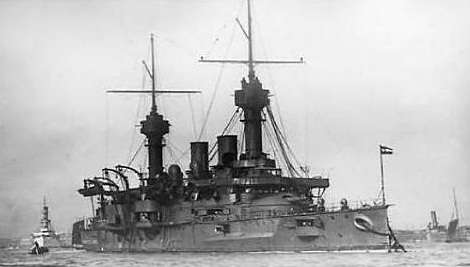
 The SMS Kaiserin und Königin Maria Theresia

Zenta was joined by the armoured cruiser SMS Kaiserin und Königin Maria Theresia, and 160 sailors from both ships (and two landed guns) were part of the assaults on the Taku forts which defended the entrance to the port of Tientsin (Tianjin). The crew of the SMS Kaiserin und Königin Maria Theresia incidentally included Georg Von Trapp, of Sound of Music fame, who was decorated for his actions.

Meanwhile in Tientsin (Tianjin) were 2,400 allied troops, mainly Russians but others as well. After the Taku forts were taken the Boxers attempted to storm the city, all but destroying the French quarter and only being back with heavy losses by the Russians. On June 18th 175 Austrian, British, German, and Italian troops sortied across the river and captured eight guns,and killed the defenders, which eased the situation until forces could arrive from Taku.

Over the following months several other Austrian cruisers arrived in China, including the SMS Kaiserin Elisabeth and SMS Aspern, and their sailors were also part of various policing and mopping up operations, up to 500 men being involved in all.

Finally, in June 1901 the Kaiserin Elisabeth and Zenta were sent home, the S.M.S. Kaiserin und Königin Maria Theresia and S.M.S. Aspern remaining on station. The Zenta arrived back in the Austrian base of Pola in October, where she was awarded a silk Flag of Honour in recognition of the actions of her crew in China.

As well as a huge indeminity paid to all the allied powers, the Austro-Hungarians actually gained territory as well, a sort of mini-Hong Kong of 150 acres at Tianjin. Although small, their first Asian colony still had 30,000 people, who became Austro-Hungarian citizens, and were under Austrian laws. It lasted until 1917.

Wednesday, 21 December 2011

The Mid Victorian Portuguese Navy

The Ships

In 1859 Husk's "The Navies of the World: their present state and future capabilities" lists the Portuguese Navy as follows...

1x Ship of the line 80 guns
The Vasco de Gama, built about 1841 in Lisbon. Although modern she was neither armoured or with steam propulsion, and so was rapidly becoming obsolete.
1x Frigate 50 guns
The Don Fernando II, built 1845, and actually still afloat and available to visit at Cacilhas near Lisbon*
3x Corvettes of 18 guns
2x Brigs of 18 guns
3x Brigs of 16 guns
1x Brig 14 guns
11x Schooners of 4-5 guns each
9x Transports
6x Steamers
including the Bartolomeu Dias, built in England in 1858, with 3 masts, but also steam propulsion

The frigate Don Fernando

"The Portuguese Navy contains 37 vessels large and mounting 362 guns and employing 2118 men. Of above 27 sailing vessels and 5 steamers are in commission the other 5 in ordinary "

It has to be said that for an imperial power with stations from Madeira to southern Africa to Goa and the East Indies, this was not terribly impressive. Even Sardinia, for example, had more steamers.

By 1863 the New York Social Science Review reports a fleet of;

1x ship of the line 76
1x frigate 44
3x corvettes
1x brig
6x schooners and cutters
11x transports
6x steam corvettes and 7x steamers

The steamer Bartolomeu Dias in 1859

At least there were now 12 steamers, but it was still a small fleet. The principle naval bases were at Lisbon and Oporto, but naval officers were often also colonial governors, for instance the Governor of Macao in 1859 was a captain in the Portuguese navy, as was the Governor General in Luanda (Angola) in 1866

Of course, as Britain's oldest ally, Portugal to a large extent was sheltering under the Pax Brittanica, any move against Goa, for example, would be inconceivable without the consent of British India. whilst Madeira would not be allowed to fall into the hands of any "major" power. But this is not to say that there were not issues.

Africa

Time and time again the Portuguese authorities in Angola and Mozambique were criticised in the House of Commons for "allowing" slave ships to take their cargo to Brazil. Royal Naval ships in Sierra Leone and later Simonstown intercepted many slave ships under the Portuguese flag, and although slave trading had been offically abolished in the Portuguese empire in 1836, over 20,000 slaves per year were exported from Angola alone during the later 1830s, mainly to Brazil. A clear distinction was also made, in Portuguese eyes at least, between slave trading and and slave ownership, which contiuned to be legal. A census in 1854 fround 60,000 slaves in Angola and 40,000 in Mozambique.

A report to the Earl of Aberdeen by the British consul in Luanda in 1845 compared 43 ships captured by the Royal Navy with 9 captured by the Portuguese and recommended strongly against leaving stretches of the coast solely to Portuguese patrols.
" in the first place because the number and efficiency of the Portuguese squadron are utterly inadequate to guard this extensive line of coast effectively many of their cruizers being employed on distant colonial service to the southward and also because the subordinate officers of the Portuguese navy to whose care this duty would necessarily be confided having with the feelings of most of their countrymen long been accustomed to regard the Slave Trade merely as a contraband traffic"
"The officers of the Portuguese naval service derive no pecuniary benefit whatever from the capture of slave vessels and consequently in this respect there is no inducement to zeal"

However, the Governor of Luanda at the time, Captain Pedro Alexandrine da Cunha, is praised for his " just and honourable principles far superior to those of the generality of his predecessors who have notoriously amassed fortunes by receiving douceurs from slave dealers".

By 1850 things seem to have improved, with, for instance, reports of the brig Corimba capturing 7 slave boats on the west African coast. The Goverenor of Angola, Jose de Coehlo de Amaral, also moved to close a loophole in the system. For years the ban on trading had been bypassed by using the independent native city of Ambriz, just up the coast from Luanda. In 1855, de Amaral sent a naval expedition to occupy the town and the traffic was stopped, and a trading city added to Portuguese territory of course. The late 1850s and 1860s saw new more dynamic governments in Lisbon developing plans to develop their African colonies, to form a "new Brazil in Africa" and the navy was reorganised around this, with more units based in Mozambique and Angola. The flagship Vasco da Gama was used to ferry extra troops down to Angola in 1859.

The flagship Vasco da Gama on a Mozambiquan stamp

The Americas

In 1849 the Vasco da Gama sailed for Brazil to show the flag, but rather embarrassingly lost all her masts in a storm and had to be towed to Rio de Janeiro.

In 1864 a Portuguese squadron including the Bartolomeu Dias was sent to Brazil to monitor Portuguese interests during the Paraguay war.

In 1865 Portugal entered briefly into the American civil war. The Confederate ironclad ram Stonewall entered Lisbon, as a neutral port, closely followed by the USS Niagara and Sacramento. The Stonewall was ordered to leave, but under international law, the US ships had to wait 24 hours before pursuing. Believing that they were about to break this law, and thus Portuguese neutrality, the guns of the ancient Tower of Belem opening fire, though causing no damage. The US ships retired, and covered also by the corvettes Sagres and Mindello, they waited with steam up until the deadline had passed. Portugal later offically apologised for the incident.

The Belem tower firing on the Niagara & Sacramento (on left)

Asia

The Portuguese had had a settlement at Macao on the Chinese coast since 1557, expanding the territory by taking over Taipa and Colerane in 1851 and 1864 respectively. One consequence of this was development of the "lorcha", a hybrid class of boat combining "junk" type sails with a "European" style hull. This type was both faster than traditional junks and simpler to build and sail than European types, and became very popular in the area.

Macau in 1859

In 1854, 4 Portuguese lorchas were part of a task force headed by USS Porpoise which attacked a pirate base near Macao, the US commander Lt Henry Rolando reporting that
"Captain Cavalho of the Portuguese navy reported that two of the junks were driven on shore and that he succeeded in making two prizes which were afterwards lost by the bad weather coming on rendering it necessary to cut them adrift from the vessel to which they were in tow".

Elsewhere in 1854 there was a showdown between a Portuguese corvette, the Don Joao, and a Chinese naval force at the city of Ningpo. Following tension between the Portuguese and Chinese in the city, which had resulted in deaths on both sides, the Portuguese sent the corvette to the city and a series of demands to the authorities there, basically requiring that the Chinese perpetrators be punished and steps be taken to ensure that local pirates did not interfere with Portuguese vessels in the future. Talks stalled and the Don Joao " took up a position opposite the east gate of the city. The Cantonese have become greatly excited. They have beached their junks in a line opposite the corvette and have taken possession of the city gate just mentioned and having mounted several guns upon the walls seem determined to make a bold resistance" (report of the US Consul in Ningpo, DB McCarter, who was firmly on the side of the Chinese in the matter).

Ning-Po in 1850

On July 10 the Don Joao, and a small fleet of 15 lorchas opened fire, sinking or capturing the junks and seizing all guns. The stand off continued until September, when a deal was reached, no Chinese were handed over but money was paid in lieu. It certainly did not end piracy in the area, McCarter reporting that
"there are fourteen Cantonese junks now lying at anchor off the city several of which are expected to leave in a few days for Chin kiangfu. A large fleet of pirates is outside mostly in the port and vicinity of Shih pu but some of them have visited the harbor of Chusan within three weeks compelling some sugar junks at anchor in the harbor to pay a heavy ransom and demanding supplies of rice &c from the city of Tinghai They are said to be about to start for the neighborhood of Shantung to intercept the trading junks engaged in the northern trade"

In 1859 there were again clashes between Portuguese and Chinese troops at Macao, and tensions continued for much of this period.

Further reading

The Navies of the World 1859
http://books.google.ca/books?id=8Xw5AAAAcAAJ&printsec=frontcover#v=onepage&q&f=false

British and Foreign state papers
http://books.google.ca/books?id=LdwMAQAAIAAJ&printsec=frontcover#v=onepage&q&f=false

US Congressional papers
http://books.google.ca/books?id=qWhHAQAAIAAJ&printsec=frontcover#v=onepage&q&f=false

Visits

The frigate Don Fernando at Cacilhas near Lisbon
http://www.revistademarinha.com/index.php?option=com_content&view=article&id=1444:dfernando-e-gloria&catid=108:historia-maritima&Itemid=295

Saturday, 12 November 2011

Austrians & Boxers (2)

In 1900 China imploded. A massive peasant uprising marched on Peking, massacring any aspect of non-traditional China, mainly foreigners and Christians. The weak Imperial government decided that could be turned to their advantage and threw in their lot with the Boxers. In Peking, hundreds of miles from the sea and any relief, the foreigners huddled together in the Legation Quarter, sandbagged the gates, and prepared to sell their lives dearly.

The Austrian Embassy was outside the central block, and though ornamental, was judged indefensible, at least by the Austrian commander, Captain Thomann. The Austrian sailors and civilians moved in with the French, which led to recriminations as it involved abandoning a large part of the perimeter. And it was jumping out of the frying pan into the fire, the French Legation was to see some of the most desperate fighting of the siege. The Chinese front line was only 50 ft away, negating a lot of the fire power advantage of the Europeans, even Boxers armed with spears and swords stood a chance of reaching the walls, and could attack at any time, day or night.

The gate of the French Legation

There was also a strong suspicion that sappers were digging under the walls, which did nothing for the nerves of the 78 Austrian and French soldiers, and 17 civilian volunteers guarding the Legation. The civilians included the Austrian Legation Secretary, Arthur Von Rosthorn, who had studied Chinese at Oxford in 1883 and had many business contacts amongst the Chinese. He and his wife Paula later wrote an account of the siege. But the quotes here come from highly readable account left by a British survivor, Putnam- Weale.*

For several days after June 20th, nothing happened. Not least because no one was in true command on either side. Within the Legation complex the candidates in terms of seniority were the Austrian captain, Thomann, the British Sir Claude MacDonald and the Japanese commander. It has to be said that there is speculation about Thomann, and his suitability for command. Responsibility for not just his troops but all the women and children in the legation, with many in the garrison believing their end was only a matter of time, would have daunted many men. Anyway, the Japanese had orders to defer to the British, and in the end MacDonald assumed command. In a way. Each nationality more or less defended it´s own embassy, and eye witnesses tell time and time again of lack of coordination. It is a tribute to MacDonalds diplomatic skills, as well as his military prowess, that the siege was survived at all.

Sir Claude McDonald

June 23rd

The whole defence nearly collapsed on the 23rd. Thomann suddenly ordered the Austrians, French and Italians to fall back on the British compound, the citadel of the defence. Troops poured into the legation, followed by the American Marines from the Tartar wall who feared they were being abandoned and their flank would be turned. It was now that McDonald really took command, with everyone in his embassy he held all the cards. He calmed everybody down and ordered them back to the outer defences, which, incredibly, had not been rushed, although the Italian embassy had been torched. The front was stabilised once more.

The Austro-French lines were defended by piquets, spread, desperately weakly, along the front. Putnam- Weale describes one consisting of four Frenchmen and two Austrians

"Here on roofs, squatting behind loopholes, and even on tree-tops, though these are very dangerous, French and Austrian sailors exchange shots with the enemy. Half a dozen men have been already hit here, but in spite of the strictest orders men are fearlessly exposing themselves and reaping the inevitable result.One giant Austrian had spread himself across the top of a roof near which I passed, with two sandbags to protect his head, and looked in his blue- black sailor clothes like an enormous fly squashed flat up there by the anger of the gods. Now leaning this way, now that, he flashed off a Mannlicher there towards the Italian Legation, where only one hundred hours ago no one ever dreamed that Chinese desperadoes would have made our normal life such a distant memory".

For a week Putnam- Weale wrote no notes, too tired and busy. During this time the Austrians lost their first casualties. Though suffering many wounded they had somehow still survived, but in the defence of the French legation Joesf Dettan fell on the 25th, then Marcus Badurina-Perić and Alfred Tavagna on the 26th and 29th.

Peking burning in June 1900

July 3rd

The Austrians and French "still sullenly cling to the ruins of the French barricades" but the Chinese now bought up two cannon.

" Under this devastating bombardment, almost a bout portant, as the French say, the last line of French trenches and their main-gate blockhouse became untenable. Pieces of shell tore through everything; men were wounded more and more quickly, ...... The French commander, disheartened by the treatment he had received from the commander-in-chief, and convinced that all his men would be blown to pieces if they remained where they were, ordered his bugler to sound the retire. The clarion's notes rose shrilly above this storm of fire, and dragging their dead with them, the Franco- Austrian survivors retreated into the fortified line behind them the Peking hotel.
Here they manned the windows and barricades of the intrepid Swiss' hostelry, which had already been heavily damaged by the Chinese guns. A determination was arrived at not to be driven out of this hotel until the last man had been killed ; it was necessary at all costs to prevent the enemy from breaking in so far. More volunteers were brought to reinforce this line, and the sinking spirits of the French were restored; for within half an hour of their retreat the bugler had sounded the advance again, and with a rush the abandoned positions were reoccupied and the Chinese driven back. Then the guns stopped their cannonade, and a breathing space was given which was sufficient to repair some of the damage done."

* http://www.archive.org/stream/indiscreetletter008256mbp/indiscreetletter008256mbp_djvu.txt

Friday, 21 October 2011

Peking 1900 (2) - Austrians and Boxers 1

In June 1900, the men and women of the International Legation Quarter in Peking found themselves under siege. They were surrounded by thousands of fanatical Boxer militia who made no secret of their desire to slaughter everyone inside, as well as regular Chinese troops - both groups had already murdered diplomats found outside the quarter. Communications with the coast had been cut and, it seemed, the end was only a matter of time. They had two advantages. By forcing all International embassies and businesses into the same area, the Chinese had inadvertently created a block that was, barely, defensible. And secondly, an International band of about 500 marines and sailors had forced their way through before the railway line to the coast at Tianjin was cut. Eight nationalities had troops in Peking, the British, Russians, French, Americans, Japanese, Italians, Germans and Austrians.

The Austrians

The Austrians were officers and men from SMS Zenta, the only Austrian warship in Tianjin at the time, about 10% of her crew. The Zenta, launched only the previous year, had actually been designed for long distance cruising, to show the Austro-Hungarian flag around the world, if you were Austrian and wanted to see the world, this was the ship to be on. She had been on an Asian tour and was on her way to Japan when recalled to help in the evacuation of embassy staff. Other Austrian ships were based in the Russian port of Port Arthur, and were destined to see action in other parts of China, but for now the crew of the Zenta were the only ones available for the international effort.


SMS Zenta & Commander Thormann

Commander Thomann, the captain of the Zenta, took Lt Kollar, Lt Von Winterhalder (the Zenta´s artillery officer), Sub Lt Meyer and Baron Boynburg-Lengsfeld, with 30 seamen and joined the Germans on a train to Peking, arriving on June 3rd. Actually, according to Putnam-Weale, Thomann had been in Peking on a pleasure trip and took command when Lt Winterhalder brought up the troops. Although not the largest contingent, they did supply a Skoda MG M1893 machine gun, which with British and American machine guns, an Italian 1pdr quick firing gun and a cannon cobbled together from bits and pieces and called Betsy gave a certain amount of fire power. The Austrian troops joined their ambassador, Baron Czikann von Walhorn, at the Austrian Legation.

Austrian marines manning a barricade

Tensions gradually increased through Peking, Boxers appeared increasingly on the streets and the Legations fortified themselves as best they could. The Legation area became an armed camp, but as one survivor, B.L. Putnam Weale, notes in his diary "Were we really playing an immense comedy, or was there a great and terrible peril menacing us? I could never get beyond asking the question. I could not think sanely long enough for the answer". later the answer came.

June 14th

Weale continues...

"The day passed slowly, and very late in the afternoon, when some of us had completed a tour of the Legations, and looked at their various picquets, I finished up at the Austrian Legation and the Customs Street. Men were everywhere sitting about, idly watching the dusty and deserted streets, half hoping that something was going to happen shortly, when suddenly there was a shout and a fierce running of feet. We all jumped up as if we had been shot, for we had been sitting very democratically on the sidewalk, and round the corner, running with the speed of the scared, came a youthful English postal carrier. The English youth had started gasping exclamations as he ran in, and tried to fetch his breath, when from the back of the Austrian Legation came a rapid roll of musketry. Austrian marines, who were spread-eagled along the roofs of their Legation residences, and on the top of the high surrounding wall, had evidently caught sight of the edge of an advancing storm, and were firing fiercely. We seized our rifles and in a disorderly crowd we ran down to the end of the great wall surrounding the Austrian compounds to view the broad street which runs towards the city gates.

The Austrian Legation, probably after the liberation of Peking given the number of soldiers

The firing ceased as suddenly as it had begun, and in its place arose a perfect storm of distant roaring and shouting. Far away the din of the Boxers could still be heard, and flames shooting up to the skies now marked their track; but of the dreaded men themselves we had not seen a single one. We found the Italian picquet at the Ha-ta end of Legation Street nearly mad with excitement; the men were crimson and shouting at one another. Bands of Boxers had passed the Italian line only eighty or a hundred yards off, and a number of dark spots on the ground testified to some slaughter by small-bore Mausers. They had been given a taste of our guns, that was all ; and, fearing the worst, every able-bodied man in the Legations fell in at the prearranged posts and waited for fresh developments. "

Later, Boxers burnt plundered and burnt the city around them, the flames clearly visible as the skies darkened. From the route of the flames that the Boxers were drawing closer again.

Boxers

" The Boxers, casting discretion to the winds, appeared to be once more advancing on the Legations. But then came a shout from the Austrian Legation, some hoarse cries in guttural German, and the big gates of the Legation were thrown open near us. The night was inky black, and you could see nothing. A confused banging of feet followed, then some more orders, and with a rattling of gun-wheels a machine-gun was run out and planted in the very centre of the street. "At two thousand yards," sang out the naval lieutenant unexpectedly and jarringly as we stood watching, "slow fire." I was surprised at such decision. Tang, tang, tang, tang, tang, spat the machine-gun in the black night, now rasping out bullets at the rate of three hundred a minute, as the gunner under the excitement of the hour and his surroundings forgot his instructions, now steadying to a slow second fire. This was something like a counter- excitement; we were beginning to speak at last. It was not so much the gun reports which thrilled us as the resonant echoes which, crackling like very dry fagots in a fierce fire as the bullets sped down the long, straight street, made us realise their destroying power.

The volunteers could now see flames from the Eastern Cathedral, where many Christians had sought sanctuary. Thomann and another senior officer conferred, but events were out of his hands....

"Volunteers to the front," shouted somebody. Everybody sprang forward like one man. A French squad was already fixing bayonets noisily and excusing their rattle and cursing on account of the dark; the Austrians had deployed and were already advancing. "Pas de charge" called a French middy. Somebody started tootling a bugle, and helter-skelter we were off down the street, with fixed bayonets and loaded magazines, a veritable massacre for ourselves in the dark. . . . The charge blew itself out in less than four hundred yards, and we pulled up panting, swearing and laughing. A very fine night counter-attack we were, and the rear was the safest place. Yet that run did us good. It was like a good drink of strong wine. "

Thomann had run with the charge and tried to get the men to return, but they pushed on into the night, finding mutilated bodies the Boxers had left behind. In the end it became clear that nothing could be done in the dark, so when the French commander recalled his men everybody else returned too. A French expedition to the cathedral found it mostly destroyed and there was no one left to rescue so they returned. Few slept that night.

Weale is critical of Thomann several times for what he considers indecision, but as he admits "Whole battalions of Boxers could have lurked there unmarked by us ; perhaps they were only waiting until they could safely cut us off.", In fact this was probably the Boxers best chance for an easy victory. At least Thomann had accompanied the charge, whilst the French commander had sensibly strayed back at the Legation.

June 16th


The Legation Compex. The Austrian embassy is up on the top right, the French further down the road

Weale wrote in his diary...
"Taking the remaining three Legations, the Belgian is hopelessly far away beyond the Ha-ta Gate line; the Austrian is two hundred yards down a side street on which is also the Customs Inspectorate";

and "The Austrian Legation is likewise a little too far away; but for the time being a triple line of barricades have gone up, having been constructed along the road between this Legation and the Customs Inspectorate. To-day, the i6th, carts are no more to be seen on these streets ; foot traffic is likewise almost at an end".

June 20th

Meanwhile fighting had erupted in other parts of China. The forts at Tianjin had been stormed by allied forces, and it is apparently this which persuaded the Dowager Empress to enter on the side of the Boxers. China was now offically at war with the allied powers. On the 19th an ultimatum had been handed to the Legation residents informing them that the Central Government would no longer be responsible for their safety. They had 24 hours after 4pm to leave Peking.

During the 20th Boxer and Imperial troops massed around the Legation complex. There were also the Muslim militia of Tung Fu-Hsiang...

"Down beyond the Austrian Legation came a flourish of hoarse-throated trumpets those wonderful Chinese trumpets. Nearer and nearer, as if challenging us with these hoarse sounds, came a large body of soldiery; we could distinctly see the bright cluster of banners round the squadron commander."
Kansu troops

"Pushing through the clouds of dust which floated high above them, the horses and their riders appeared and skirted the edge of our square. We noted the colour of their tunics and the blackness of the turbans. The manner in which they so coolly rode past fifty yards away must have frightened some one, for when I passed here an hour later the Austrian Legation and its street defences had been suddenly abandoned by our men. "

"At the big French barricades facing north an angry altercation soon began between the French and Austrian commanders. The French line of barricades was but the third line of defence here, and only the streets had been fortified, not the houses ; but by the Austrian retreat it had become the first, and the worn-out French sailors would have hastily to do more weary fatigue-work carting more materials to strengthen this contact point. "

Then..
"bang-ping, bang-ping, came three or four scattered shots from far down the street beyond the Austrian Legation. It was just where Tung Fu-hsiang's men had passed. That stopped us talking, and as I took a wad of waste out of the end of my rifle I looked at my watch 3.49 exactly, or eleven minutes too soon. I ran forward, pushing home the top cartridge on my clip, but I was too late. "A quatrecents metres" L , the French commander, called, and then a volley was loosed off down that long dusty street our first volley of the siege. "

Further Reading

Indiscrete Letters From Peking by BL Putnam Weale is an extremely readable account of the siege. Actually, it is more discrete than it appears, as the real name of the author was Bertram Lennox Simpson, an offical in the Chinese Maritme Customs Service. It is available online.