Showing posts with label Hanover. Show all posts

Saturday, 14 July 2012

Hanoverians at the Siege - Gibraltar 1779-83

Extracted from "Geschichte de churhannoverschen Truppen in Gibraltar, Minorca und Ostindien" by Ernst von dem Knesebeck, published in 1845. Available as a google ebook.

To Gibraltar

August de la Motte, the senior Hanoverian commander during the Siege

It soon became clear in 1775 that Britain did not have enough troops to calm the colonial rebellion in America. So the English parliament approached George III, who was also king of Hanover, and they requested the use of Hanoverian troops. He agreed and wrote to Field Marshal von Spoercken to release five battalions. These would be paid by the English, but were only be available for use in Europe, and would be subject to their own rules, justice and religion. The idea was that they could release British garrison troops for the Americas. Two battalions were sent to the island of Minorca, then British, and three to Gibraltar.

das 1. Bataillon von Reden, under Obristlieutenant von Walthausen; replaced by von Dachenhausen when von Walthausen drowned in November 1775

das 1. Bataillon von Hardenberg, later known as von Sydow, under Obristlieutenant von dem Bussche. Von dem Bussche returned to Hannover in 1778 and was replaced by von Hugo.

das 1. Bataillon la Motte, under Obristen la Motte and Major von Schlepegrell.

Each battalion consisted of one grenadier and five musketeer companies, with a total including officers and noncommissioned officers of 473 men, as well as two women. The red and white uniform was remarkably similar to the British troops, though Hanoverian officers wore a characteristic gold sash.

 Gustav Von Dachenhausen

By November 1775 they had been shipped down to Gibraltar, where they were heartily welcomed by the Vice-Governor, Major-General Boyd, and shown to their barracks in the city. The three English regiments that the Hanoverians were replacing were reportedly not best pleased to be leaving for the forests of America, and the Hanoverians soon discovered why. Gibraltar at this time was a very congenial posting, the southern climate was comfortable, the food good, and the Rock interesting. Although most days, after service, the troops were put to work on the fortifications they received a working grant, and most considered themselves well paid.

"Many a trip was undertaken by the Hanoverian officers after the Spanish cities in the area, even to Italy, Africa and the African pirate states. In the fortress were the hospitable rooms of the vice-governor of officers to open once a week, and also to the other days there was no lack of social conversations. The arrival of the first governor (General Elliot) in no way interfered with these pleasant conditions, and soon did this great man's love and respect for the Hanoverian brigade just to win as much as had been both the General Boyd."

Start of the Siege - 1779-1780

Governor Elliot was expecting trouble, but a sudden declaration of war in 1779 took him by surprise. Several officers from the garrison were vacationing in Spain, and one was taken prisoner. The Spanish, based in a camp at San Roque, consisted of 18 battalions of infantry, one battalion of artillery, eight squadrons of cavalry and 4 squadrons of dragoons. At the same time the Bay of Gibraltar was blockaded by a Spanish fleet of three battleships, three frigates and nine smaller vessels. In comparison, the garrison of Gibraltar, had 5 English and 3 Hanoverian battalions, which including the artillery reached a strength of almost 5,400 men. There was also a volunteer corps of Englishmen and Germans, with 2 officers and 80 privates, under Lieutenant Belleville of the La Motte regiment. They had in the harbour one ship of the line, of 60 guns, and three smaller ships.

From July 1779 to mid-January 1780 only 15, mostly in small boats made it past the blockade with food, and lack of meat and fresh food became a  real issue. An armed guard had to be put on the bakers, so great was the demand. The weekly ration of a soldier consisted of 7 pounds of wheat bread or hardtack, 2 pounds of salted beef and 1 pound of salt pork, 4 pints of peas, 3 of oatmeal and 10 ounces of butter. The latter was later withdrawn and replaced by more oatmeal. On 11th January 1780 even this was reduced, with the loss of the pork and one pound of beef. Apart from this though, service in the fortress was not too severe and the health of the soldiers was pretty good. At any one time only 600 out of 6,000 were needed for piquet duty, and time hung heavy for the rest. They were also well protected from enemy fire, only 30 men were lost from the three Hanoverian battalions in 1780.

On the night of 30 September 1st October 1780 the Spanish made a raid on the palisades of the Bay side and caused some damage, but worse was prevented by the "vigilance and intrepidity of two Hanoverian soldiers who were here on duty".

1781 - the counter attack

The relief convoy in April 1781 was a huge relief, with massive celebrations all round, and in fact quite a lot of drunkenness until order was restored. The downside was a huge increase in Spanish bombardment, first against the transports and then against the town. 25 Hanoverians were wounded, and 156 in the garrison as a whole. Monotony was replaced by labour as the bastions were continually repaired, and new ones cut from the rock.

Throughout the autumn work continued on the Spanish side, building more and more batteries, and it was clear that something had to be done. In secret, General Elliot started planning a sortie. He was helped when on 20th November two Spanish deserters arrived, and could give detailed plans of the batteries and their layout. They also described Spanish morale as very low, and the state of things on general to be sloppy. On the night of the 26th November 1781, the British attacked,. It was an incredibly risky operation. They had to cover 500 yards to the Spanish lines, and then another 1,000 to the batteries and there was only one exit, and entry, gate. They were organised into three columns, with Hanoverian troops forming the bulk of the right hand column under von Hugo. This consisted of the von Hardenberg regiment (296 men), together with the grenadier companies of the von Reden and la Motte Regiments (142), the light company of the British 56th Regiment (57) together with 25 artillery men and 50 labourers, 570 in total. The right column was to attack the San Carlos battery on the east of the Spanish lines. The British troops in the centre column were under the Hanoverian Dachenhausen.

 Senior allied officers during the sortie, with Gibraltar behind

At midnight the troops were gathered, and 3 clock in the morning on 27 November, after the moon, which shone very bright, had set, they left Gibralltar. In the darkness they came first across the Spanish Walloon Guard, and upon being challenged Lieutenant Hugo shouted "Krena6iers ällsnovre! " and they rushed the 7ft high barricade with little resistance. A portion of the Hardenberg Regiment had strayed in the darkness and came upon the San Carlos battery unexpectedly, from where they received a volley but they carried on, reinforced by the rest of the Regiment, and this was the only mistake of the night. At a given signal the batteries in Gibraltar opened up and the Spanish, thrown into confusion, retired from the battery line. With incredible speed troops swarmed over the batteries and fascines, attaching wreathes of pitch which they set alight, and spiking the guns. They were covered from counter attack by the combined light and grenadier companies and the Hardenberg Regiment. When trails of powder were lit to the magazines, the order was given to withdraw, again covered by the Hardenberg Regiment, with the magazine exploding like an earthquake before they reached the gate. By 5 o clock they were inside.

The sortie had been incredibly successful, the siege works burned for days and several magazines had been lost, all for remarkably little loss. Of the Hanoverians, the Hardenberg Reigment lost 2 dead and one wounded, von Reden 1 dead, and la Motte escaped casualties.

One consequence of the sallie was increased public perception in England, especially at a time of almost unrelenting bad news. George III, as Hanoverian head of state, promoted La Motte to Lieutenant Genral, and von Hugo and von Dachenhausen to Colonel & Brigadier.

The Spanish now turned their fire again on the city, and much of it was destroyed, though the fortifications were almost untouched. There were again few casualties, though several men from La Motte were lost when one of the magazine at the Willis batteries received a direct hit and exploded. But conditions on the Rock were now worse than ever, the troops sleeping in tents, many of the non-combatants in whatever ruins or huts they could find. There was plenty of salt beef, but no fresh food, and scurvy broke out again.

1782-4 - the Grand Bombardment and home.
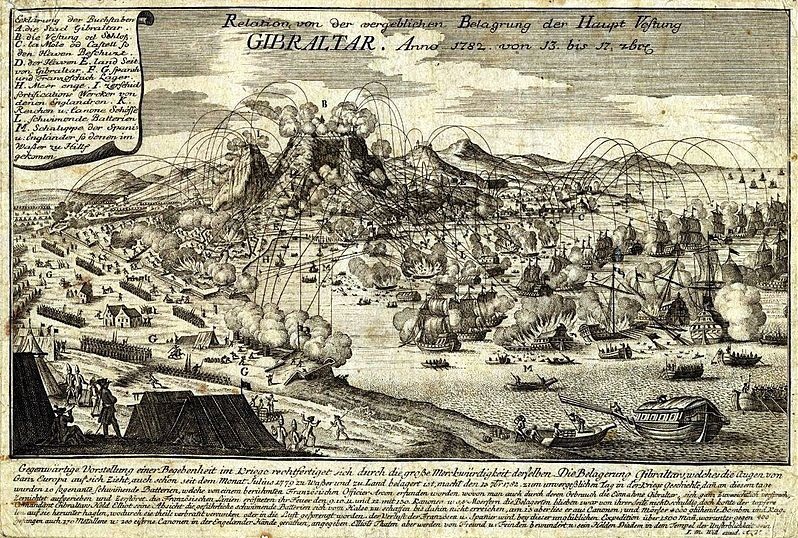
A German (Hanoverian?) portrayal of the bombardment

During the early months of 1782 the Spanish reconstructed their earthworks, with no expense being spared, and of course, defences much improved. They also considered what new methods they could use, even poison gas, but they decided to build floating batteries, and this went ahead in great secrecy. Meanwhile, the British and Hanoverians had been strenghtened to 7,500 men, and were making innovations of their own, including a cannon which could be depressed 20 degrees, for firing from the great height of the Rock. They also developed "heated shot". Actually, this wasn't new, but was hardly ever used as it was technically very difficult, the heat tending to ignite the powder of the cannon prematurely. But they had lots of cannons, and time, to play with and eventually got it right. A sergeant in the La Motte Regiment, Schwependik, a blacksmith by trade, invented an oven that could produce several glowing shot at once. He received a life long pension from the English government.

The Spanish also built up their assault forces, under the command of the Duke of Crillon, who had just captured the island of Minorca, and the Hannoverian garrison there. There was also a French corps under Falkenhayn of 4,000 men, which although small in comparison to the Spanish forces, almost matched the garrison by itself. There were many more cannon, more ships, and the floating batteries. There were also landing craft, flat bottomed to convey troops across the bay after the defences had been pounded to rubble. It looked like this time the Spanish could not possibly fail.

On 9th September 1782 all the land batteries and gun boats started firing, joined on the 12th by a Franco Spanish fleet, and on the 13th by the floating batteries, which were meant to bear the brunt of the attack. The British responded by the heaviest fire they could manage, concentrated initially on the boats towing the floating batteries, which were crewed by criminals as the work was so obviously dangerous. To their dismay the British found that the floating batteries themselves were more or less immune to cannon fire. Only the heated shot seemed to make any impression, and even then the artillery battle went on for hours. By 3pm smoke was blowing around the bay, but it was not until 8pm that the garrison could see boats evacuating crews from the floating batteries. By 11pm a shipwrecked Spanish ship bought news that the Spanish were starting to retire, but still the battle kept on, artillery crews replaced with sailors who knew how to work the guns. By 3am several floating batteries could be seen in flames, which only served to illuminate the others to make better targets. Before daybreak a counterattack with gunboats drove off the boats protecting the batteries and the danger was over. Overall, Spanish losses were estimated at about 2,000, losses in the garrison were just 16 killed and 69 wounded.

Although moral in the siege lines was now low, the Spanish court did not give up, and the blockade continued. Fresh food was still low. The arrival of Howe's convoy in October relieved matters though, and brought the garrison up to 8,000 men. Spanish preparations for another attack continues, but halfheartedly, and in February 1783 news came of the Treaty of Versailles. On March 12th Governor Elloit met the Duke of Crillon outside the walls, they shook hands and peace was declared.

It was over a year before the Hanoverian brigade could return home, but in August 1784 they embarked and in September they were back in the river Weser at Geestendorf (Bremerhaven). They were met by Major Genreral von Busse and one by one discharged from English service. They marched to their respective garrisons at Nienburg, Verden and Hameln, where they were received as heroes.

As an aside, the three Hanoverian Regiments were granted the battle honour "Gibraltar". Their successors in the German Army still carried this into World War 1.

Friday, 12 August 2011

Red City - the Mutinies of Semarang

Semarang in Indonesia is now known locally as the Red City, after it´s Communist links. It was where Dutch immigrants started the local Communist party in 1920, and promptly started fighting with the Socialists. The city has had a troubled history.

The African mutiny, 1840

Local (left) and African soldiers in the KNIL

The Dutch in the 1830s faced a problem. They had a burgeoning empire in the East Indies, but it had to be policed. There were good local soldiers available, for instance the Amboinese, but there had already been one Javanese revolt in 1829 and arming more locals did not seem a good idea. Equally there were few Dutch willing to volunteer, and it was illegal to send Dutch conscripts to the East. The solution was to recruit African soldiers, who it was presumed would cope better with the climate, and have little reason to align themselves with the local population. To further ensure their loyalty, they were promised "European" status in terms of pay and conditions.
The original idea was to recruit Ashanti warriors, who had a superb reputation. Unfortunately, the Ashanti saw little point in volunteering for 15 years service in a distant land when they had a good thing going at home. But they were amenable to selling some of their slaves to the Dutch. These slaves were then technically "freed" (important to prevent interference from Royal Navy anti-slavery patrols on the West African coast) and the fee regarded as an advance on their pay. Over 2,000 were shipped to join the Dutch East Indies Army, the KLIN.

Now, the "European" status might have been seen as a bureaucratic slight of hand in the Hague, but it was taken very seriously by the Africans. On the other hand, to the Dutch officers in Batavia, they were unaccustomed to any European ways let alone military training, and of course hardly any spoke Dutch, or even the same African languages. By 1838 there were reports of disturbances throughout the army, Dutch officers reported that the Africans were "'choleric, quick-tempered and extremely insolent" and recommended only one African company per battalion, although "during military expeditions they demonstrated bravery and fearlessness, even more so than the Europeans. In combat their ardour needed to be tempered, otherwise they ignored the orders of their officers". Importantly, "it was repeatedly emphasised that the Africans looked down on the native population."

In December 1840 the military tribunal in Semarang tried a case of mutiny. This wasn´t the first incidence of trouble, but it was the first to go to court. In the garrison town of Kedong Kebo in central Java the 4th Infantry battalion had mutinied, or rather the 3rd, 4th and 5th African companies did. The cause was not a general sense of "anti-colonialism", but a feeling that they were losing their status as "Europeans" and being treated like "natives". Actually, a justified grievance as their bedding had been removed and their pay down graded. On 16th April the 3rd and 5th companies disobeyed their officers and stormed into the kitchens, from where they returned armed with wooden sticks. With the 4th company they then went for the arsenal "shouting rebellious slogans", but the commander had had prior warning, and filled it with European troops. The mutineers were dispersed and fled into the bush, followed by armed patrols. With little local support they were soon captured, and the ring leaders sentenced to 25 lashes and 2 years in prison, the rest to 14 days in prison. In 1841 there was another revolt on Sumatra that left 2 Africans dead, and in December 1841 recruitment in West Africa was stopped altogether

The use of African soldiers in the KNIL is discussed in more detail in "African mutinies in the Netherlands East Indies" (2003) by Ineke van Kessel, available by open access on the web

The Swiss mutiny, 1860

Lt Romswinckel

By 1860 Semarang was a major commercial centre, with about 30,000 people employed in import and export businesses, and a trade of 30 million guilders per year. The European population was 2nd only to Batavia. Nonetheless the KLIN still had the same manpower problem, and now they turned to the Swiss. The most famous mercenaries in Europe, surely this couldn´t go wrong? In Semarang it did. The "numerous" Swiss garrison revolted and terrified the merchants of the city with the prospect of "murder and looting". Fortunately for them a Dutch officer, Lt Joost Hendrik Romswinckel was on hand. He had already seen service in Boni, where he won the Military Order of William, and he had a reputation for calmness under fire. In one case he had hidden a leg wound from his native troops and only attended to it later in secret. This calmness served him well again, with a "handful" of loyal troops he faced down the mutineers and reestablished order. The city awarded him a jewelled sword in gratitude.

The Japanese mutiny, 1945

Japanese troops in Semarang, 1942

Like the rest of Java, Semarang was occupied by the Japanese in WW2. When they surrendered this left a vacuum which Indonesian nationalists immediately filled, declaring Independence on 17th August 1945. Unfortunately, in effect, this meant a complete breakdown in law and order, with murder and looting rife. Although the 5,000 Dutch in Semarang were worried, the 40,000 Chinese were terrified - they had suffered particularly under the Japanese and now were targeted by the Indonesians.

By this time British and Dutch troops had reestablished control in Batavia, but the Indian troops in Semarang were struggling. They had successfully evacuated many POWs, but power and water had been cut off and thousands of British, Dutch and Eurasians were forced into internment camps. There was another source of troops however. The Japanese battalion in Semerang under Major Kido had been confined to barracks since the surrender, though they had occasionally been used under strict Indian control to maintain order. Now Kido took matters into his own hands. In the early hours of October 15th the Japanese left their barracks, without permission, and moved into the city. They cleared the immediate area and then secured the internment camps. Next day, under heavy machine gun and sniper fire, they stormed the town jail, finding the bodies of 85 murdered Japanese, but rescuing another 50, and over 300 Europeans due to be executed the next day.

More Indian and British troops arrived, especially the 10th Gurkha Rifles and 5th Parachute brigade and the city came back under control. Electricity and water were reestablished, and in 1946 the city was handed back to Dutch troops. Kido's "mutiny" was soon over, but it saved a lot of lives, as Captain D.B. Friend, of the Gurkhas reported - 'There is little doubt that the internees at Semarang owed their lives to Kido and his men, for it was they who prevented the Indonesians from capturing the camps and massacring the inmates before the arrival of British troops'

The most famous mutiny of all

The mutiny

Ok, the Mutiny on the Bounty didn't start in Semarang, but Bligh and his companions did pass through on their way home, on Thursday September 24th 1789. As well as remarking that "the Custom among the dutch is to go to Sleep immediately after Dinner their time of Dining being precisely at Noon", he left this description...

"In the Morning Mr. de Bose did me the favour to show me the environs of this place . Its situation is pleasant, with fine Roads like Bowling Greens, for the Country except far back is level without any rising Grounds and is well Watered. The generality of the Houses are not well calculated for the Country but none of the superior ones particularly this of Mr. de Bose are Airy and built with Taste. The Chinese Town is apart from the Europeans, and so are the industrious people. The Markets are Large and supplied with great abundance of Legumes and Fruit and every article of Food is to be got at a very cheap rate.

But what does great honor to the Europeans here is a publick Hospital under the direction of Mr. Johannes Jacobus Abegg who is first Surgeon. Perhaps a more Airy, or a Situation more desirable for a Sick Man cannot be found, or is it possible for more cleanliness to be observed in any place whatever.


Here's also a public School supported by contributions and some other Helps from such Scholars as are able to pay for their education.The Mathematical Sciences are regularly and well taught and every young person may be properly educated to form a Complete Sea Officer. The Head Master Mr. Stainmitz is possessed of a few necessary Instruments but he wants a little practical knowledge of the use of them and of the manner of making Observations.


The Town is fortified and surrounded by a Wall & Ditch, on the whole perhaps they can mount 80 peices of Cannon. The Troupes are Commanded by a Colonel and their number may amount to 300 effective Europeans. Among those Officers who have honord me with a Visit was a Mr. C. C. Van Arnschild an Hanovarian Officer now in the Company Service whose Father is a General in Hanover".


Thursday, 7 July 2011

Hanoverian Standoff - the Maidstone affair of 1756

On Monday 13th September 1756 a German soldier walked into a shop in Maidstone, Kent, to buy some handkerchiefs. What happened next helped bring down a government and led to a big change in military policy.

Britain was at war, and it was not going well. Since 1754 Britain had been fighting a losing war against the French in North America, and now this had spread to Europe, to become the Seven Years war. Defeats in Ohio and the loss of Menorca in the Mediterranean had raised well founded fears of a French invasion, but most of England's regular forces were abroad.

To make up the short fall the government hired troops from Germany, or rather the German states of Hanover and Hesse. These were not technically mercenaries, which are hired individually, but auxiliaries hired as units from the rulers of the state. A huge 12,000 had been hired, and they arrived in May. They had to go somewhere, so a enormous camp was set up at Cox's heath (modern Coxheath), an area of open ground outside of Maidstone, presumably as it lay on the obvious invasion route from France. The disruption and anxiety this caused locally can be imagined, but draconian discipline ensured that the troops were well behaved and they were, for the most part, accepted. After all they had to buy their supplies, and handkerchiefs, somewhere.

Coxheath Camp 20 years later in 1778, this time with 15,000 Hanoverians

Trouble in the Haberdashers

Christophe Guilleme Schroder, who was from Hanover, entered the shop with his friend Winckler and asked to see some silk handkerchiefs. The owner, Christopher Harris showed some, which Schroder accepted, paid for and tried to leave. Unfortunately he had 8, but only paid for 6. This might have been a mistake, or as Harris claimed, Christophe might have slipped in another two when his back was turned. Now it´s not mentioned in the accounts, but Harris must have had some trouble with Germans, or soldiers, before, or maybe his gout was playing him up, because he immediately charged Schroder with theft and demanded he be taken to the local authorities. According to the Hanoverian account he used "offensive language". Well, a crowd had gathered by now, and Schroder was taken in front of the mayor of Maidstone, called, slightly suspiciously, John Harris. Schroder was charged with common felony, and committed to jail to wait the next quarter sessions, or trial date. Most commentators at the time considered that he got off lightly, although Maidstone prison was condemmed around 1800 for it's terrible conditions even by the standards of the day, so not the pleasantest of places.

The commander of the Hanoverian troops in Maidstone was Georg Ludwig, Graf von Kielmansegg, and he wasn't accustomed to having civilians telling him what to do. Next day, he went to the mayor and demanded that Schroder be released to him, claiming that he was under Hanoverian, not English jurisdiction. The major refused, at which point Kielmansegg threatened to march troops into town and get him. This where the affair starts getting serious. News of the threat spread all over the country, but especially in Kent where they suddenly became aware that there were 12,000 foreign troops in their midst with very little to stop them. Many comparisons were made with Hengist and Horsa, Saxon auxiliaries of the Roman-British who had rebelled and set up their own kingdom in Kent - the alliteration with Hanover and Hesse helping no end in this regard. Plays on the words "outside the law" and "outlaws" were also quite tempting.

A contemporay cartoon of the event. Hanoverians, with handkerchiefs, kept out of the pub by stout Kentish men. The Hanoverians, being outside English law, are "outlaws".

Nonetheless, Mayor Harris still refused to release Schroder so Kielmansegg went up a level, to the government in Whitehall. Unfortunately, most senior ministers were away so it fell to a junior minister, the Earl of Holderness, to make a decision. He did, ordering the mayor to release Schroder at once, which he reluctantly did. Harris could have let the matter drop, but his revenge was to write again to Whitehall demanding "clarification" of the jurisdiction of town and Hanoverians. This forced the entry of the Attorney General and other senior figures, and bought the whole thing much more into the public domain.

Holderness's Problems

Earl of Holderness

Holderness found himself in the middle of a political firestorm, various controversies converging on him at once. They can perhaps be summarised as follows

a) A military officer had threatened the mayor of an English country town, and Holderness had supported the army. This did not go down well. Soldiers were regarded at this time with ambivalence, necessary but dangerous and frankly, almost criminal. Britain spent a fortune on her fleets, but the army was kept as small as possible. They were also regarded a potential threat to liberty, and the Maidstone affair" played right into this prejudice.
b) The military officer was foreign.
c) Not only foreign, but Hanoverian. George II was also King of Hanover, and was widely rumoured to prefer his homeland, not least because there he was an absolute monarch. The Jacobite rebellion was only 11 years earlier, and although there was little enthusiasm for a Stuart revival in England, there wasn´t a great deal of popularity for the Hanoverians either. There was always the suspicion that English interests would be second to Hanoverian ones, which the Schroder affair rather suggested. Holderness himself was generally held to owe his position to royal patronage rather than any particular talent, so it was especially unfortunate that he was the one handed this hot potato.
d) The government of which Holderness was a part, lead by the Duke of Newcastle, was already unpopular due to the debacle at Menorca, and was unlucky enough to face a talented political operator in the form of William Pitt who knew a good stick to beat the government when he saw one.

There were of course counter arguments. It made sense for a threatened, rich, country with a small army to hire troops elsewhere, and no one claimed the Germans were anything but good troops. Being Hanoverian might make them more loyal to England, not less - after all they shared the same king. In fact, of 12,000 troops the only claim laid against them was stealing some handkerchiefs, and thats debatable. In contrast, an officer of Foot, John Lauder, had been executed in Maidstone in August for killing a pot boy, William Forster, with his sword "in the heat of passion and liquor".

Aftermath

The country was not in the mood to listen to the Hanoverian side. Kielmansegg was sacrificed and sent back to Hanover, but it wasn't enough and by December Newcastle was out and Pitt was in charge. The King refused initially to sack Holderness, but he soon went too. At the end of November, 4 battalions of Hanoverians marched to Chatham and embarked for Germany, the transports returning for another 3 battalions. They had, incidentally, been camped on Cox's Heath all this time "notwithstanding the severity of the weather".

The incoming government started a process of forming a citizens militia, which was felt to more patriotic. Men would be trained, but continue their normal professions - lack of military training was held to be balanced by fervour in defending their homes and families. Of course Germans were still hired, in both the American Revolution and the wars against Napoleon, but home defence was to rely on English forces.

I would like to tell you what became of Schroder, but I cannot, it is not known. A local paper, the Kentish Post, reported that he was lashed repeatedly, and then thrown out of the army, but another reorted that he couldn't be tried, as Harris refused to testify in front of a foreign court. Let's imagine he returned home, married a beautiful Fraulein and set up shop back in Hanover. Selling handkerchiefs.

A more detailed description of the Maidstone affair, especially the political implications, can be found in an article by M McCormack - Citizenship, nationhood, and masculinity in the affair of the Hanoverian soldier, 1756. The Historical Journal, 2006 - Cambridge Univ Press
The rest comes from various contempory documents

Sunday, 19 June 2011

The Raid on Havre de Grace 1813

In May 1813 a small squadron of frigates under George Cockburn* was cruising the coast between Baltimore and Canada, with the dual aims of capturing privateers (pirates) and forcing the diversion of regular US troops from Canada. After a very successful raid on Frenchtown Cockburn resolved to attack the fortified town of Havre de Grace. This is his report (available online at the London Gazette).

Admiral George Cockburn

His Majesty's Ship Maidstone, Tuesday night, 3d May 1813, at Anchor off Turkey Point.

SIR,
I HAVE the honour to inform you, that whilst anchoring the brigs and tenders off Specucie island, agreeable to my intentions notified to you in my official report of the 29th ultimo, No. 10, I observed guns fired and American colours hoisted at a battery lately erected at Havre-de-Grace, at the entrance of the Susquehanna river; this of course immediately gave to the place an importance which I had not before attached to it, and I therefore determined on attacking it after the completion of our operations at the island; consequently having sounded in the direction towards it, and found that the shallowness of the water would only admit of its' being approached by boats, I directed their assembling under Lieutenant Westphal**, (first of the Marlborough) last night at twelve o'clock, alongside the Fantome, when our detachments of marines, consisting of about one hundred and fifty men, (as before) under Captains Wybourn and Carter, with a small party of artillerymen, under Lieutenant Robertson, of the artillery***, embarked in them, and the whole being under the immediate direction of Captain Lawrence, of the Fantome, (who with much zeal and readiness took upon himself, at my request, the conducting of this service) proceeded towards Havre, to take up under cover of the night, the necessary positions for commencing the attack at dawn of day.

Rocket boats - the crew shelter behind wetted sails during firing

The Dolphin and Highflyer tenders, commanded by Lieutenants Hutchinson and Lewis, followed for the support of the boats, but the shoalness of the water prevented their getting within six miles of the place. Captain Lawrence, however, having got up with the boats, and having very ably and judiciously placed them during the attack, a warm fire was opened on the place at daylight from our launches and rocket boats, which was smartly returned from the battery for a short time, but the launches constantly closing with it, and their fire rather increasing than decreasing, that from the battery soon began to slacken, and Captain Lawrence observing this, very judiciously directed the landing of the marines on the left, which movement, added to the hot fire they were under, induced the Americans to commence withdrawing from the battery, to take shelter in the town.

Lieutenant G. A. Westphal, who had taken his station in the rocket boat close to the battery, therefore now judging the moment to be favourable, pulled directly up under the work, and landing with his boats crew, got immediate possession of it, turned their own guns on them, and thereby soon obliged them to retreat with their whole force to the furthest extremity of the town, whither (the marines having by this time landed) they were closely pursued, and no longer feeling themselves equal to a manly and open resistance, they commenced a teazing and irritating fire from behind the houses, Walls, trees, &c. from which I am sorry to say, my gallant first lieutenant received a shot through his hand whilst leading the pursuing party; he, however, continued to head the advance, with which he soon succeeded in dislodging the whole of the enemy from their lurking places, and driving them from shelter to the neighbouring woods, and whilst performing which service, he had the satisfaction to overtake, and with his remaining hand to make Prisoner,-and bring in a captain of their militia.

We also took an ensign and some armed individuals, but the rest of the force which had been opposed to us, having penetrated into the woods, I did not judge it prudent to allow of their being further followed with our small numbers, therefore after setting fire to some of the. houses, to cause the proprietors (who had deserted them, and formed part of the militia, who had fled to the woods,) to understand and feel what they were liable to bring upon themselves, by building batteries and acting towards us with, so much useless, rancour.


An American propaganda poster of the time, so perhaps of limited accuracy

I embarked in the boats the guns from the battery, and having also taken and destroyed about one hundred and thirty stand of small arms, I detached, a small division of boats up the Susquebanna, to take and destroy whatever they might meet with in it, and proceeded myself with the remaining boats under Captain Lawrence, in search of a cannon foundry, which I had gained intelligence of, whilst on shore in Havre, as being situated about three or four miles to the northward, where we found it accordingly, and getting possession of it without difficulty, commenced instantly its destruction, and that of the guns and other materials we found there, to complete which, occupied us during the remainder of the day, as there were several buildings and much complicated heavy machinery attached to it.

It was known by the names of the Cecil or Principio foundry, and was on of the most valuable works of the kind in America; the destruction of it, therefore, at this moment, will I trust prove of much national importance.


In the margin (see below) I have stated the ordnance taken and disabled by our small division this day, during the whole of which we have been on shore in the centre of the enemy's country, and on his high road between Baltimore and Philadelphia. The boats which I sent up the Susquehanna returned after destroying five vessels in it, and a large store of flour; when every thing being completed to my utmost wishes, the whole division re-embarked and returned to the ships, where we arrived at ten o'clock, after being twenty-two hours in constant exertion, without nourishment of any kind, and I have much pleasure in being able to add that, excepting Lieutenant Westphall's wound, we have not suffered any casualty whatever.

The judicious dispositions made by Captain Lawrence, of the Fantome, during the preceding night, and the able manner in which he, conducted the attack of Havre, in the morning, added to the gallantry, zeal and attention shewn by him during this whole day, most justly entitle him to my highest encomiums and acknowledgements, and will, I trust, ensure to him your approbation; and I have the pleasure to add, that he speaks in the most favourable manner of the good conduct of all the officers and men employed in the boats under bis immediate orders, particularly of Lieutenants Alexander and Reed, of the Dragon and Fantome, who each commanded a division.

Of Lieutenant G. A. Westphall whose exemplary and gallant conduct it has been necessary for me already to notice in detailing to you the operations of the day, I shall only now add, that for a thorough knowledge of his merits (be having served many years with me as first lieutenant) I always, on similar occasions-, expect much from him, but this day he even outstripped those expectations, and though in considerable pain from his wound, he insisted on continuing to assist me to the last moment with his able exertions, I therefore, Sir, cannot but entertain a confident hope that his services of today -and the wound' he has received, added to what be so successfully executed at French Town (as detailed in my letter to you of the 29th ultimo), will obtain for him your favourable consideration and notice, and that of my Lords Commissioners of the Admiralty.


HMS Apollo, sister ship to HMS Maidstone, Cockburn's flagship

I should be wanting in justice did I not also mention to you particularly the able assistance again afforded me by Lieutenant Robertson, of the artillery, who is ever a volunteer where service is to be performed, and always foremost in performing such service, being equally conspicuous for his gallantry and ability; and he also obliged me by superintending the destruction of the ordinance taken from the foundry,

To Captains Wyborn and Carter, who commanded the marines, and shewed much skill in the management of them, every praise is likewise due, as are my acknowledgements of Lieutenant Lewis, of the Highflyer, who, not being able to bring his vessel near enough to render assistance, came himself with his usual active zeal to offer his personal services. And it is my pleasing duty 'to have to report to you in addition, that all the other officers and men seemed to vie with each other in the cheerful and zealous discharge of their duty and I have therefore the satisfaction of recommending their general good conduct on this occasion to your notice accordingly.
'I have the honour to be, &e, (Signed') G. COCKBURN, Rear Admiral.

Taken from the battery at Havre-de-Grace - 6 guns, twelve and six-pounders.
Disabled in the battery for protection of foundry - 5 guns, twenty-four pounders.

Disabled, ready for sending' away from foundry - 28 guns, thirty-two pounders
Disabled in boring house and foundry - 8 guns and 4 carronades, of different calibres.

Total 51 guns, and 130 stand of small arms.


* Cockburn was the naval commander during the burning of Washington, in retaliation for the sacking of Toronto. He also raised a Corps of Colonial Marines from former United States slaves. The corps served in several actions up and down the Atlantic coast including the victory at St Peter, and the occupation of Cumberland Island, where they helped the freeing and emigration of several hundred slaves.

** Lt Westphal had an extraordinary, charmed, life. Born in Preston, Nova Scotia, in 1785 George was the son of a retired Hanoverian officer. He joined the Royal Navy at 13, and in 1805 found himself on HMS Victory. During the fighting he was severely injured and carried below deck, where Nelson lay dying. Nelson's coat was used as a pillow, but his hair, matted with blood, became so entangled with the coat button that they had to be cut off. Westphal kept the buttons as souvenir. Further adventures included escaping from a prison in Guadaloupe, leading a section of gunboats against Flushing and innumerable other escapades. He served with Cockburn, where he made a very good impression and saw a lot of action, including leading the raid on Frenchtown.
Made captain in 1814, he was knighted in 1823 and in 1846, George Westphal was appointed a naval aide-de-camp to Queen Victoria.
George's brother Philip also became an admiral, and there is a school named after them both in Nova Scotia.

*** members of the Royal Artillery stationed at Bermuda. Congreve rockets were basically huge fireworks, developed originally in India and modified by the British.

**** The Lockhouse museum in Havre stages a reconstruction of the raid every year

Royal Marines